Leaving Dubai for the Summer? How to Prepare Your Home 2026
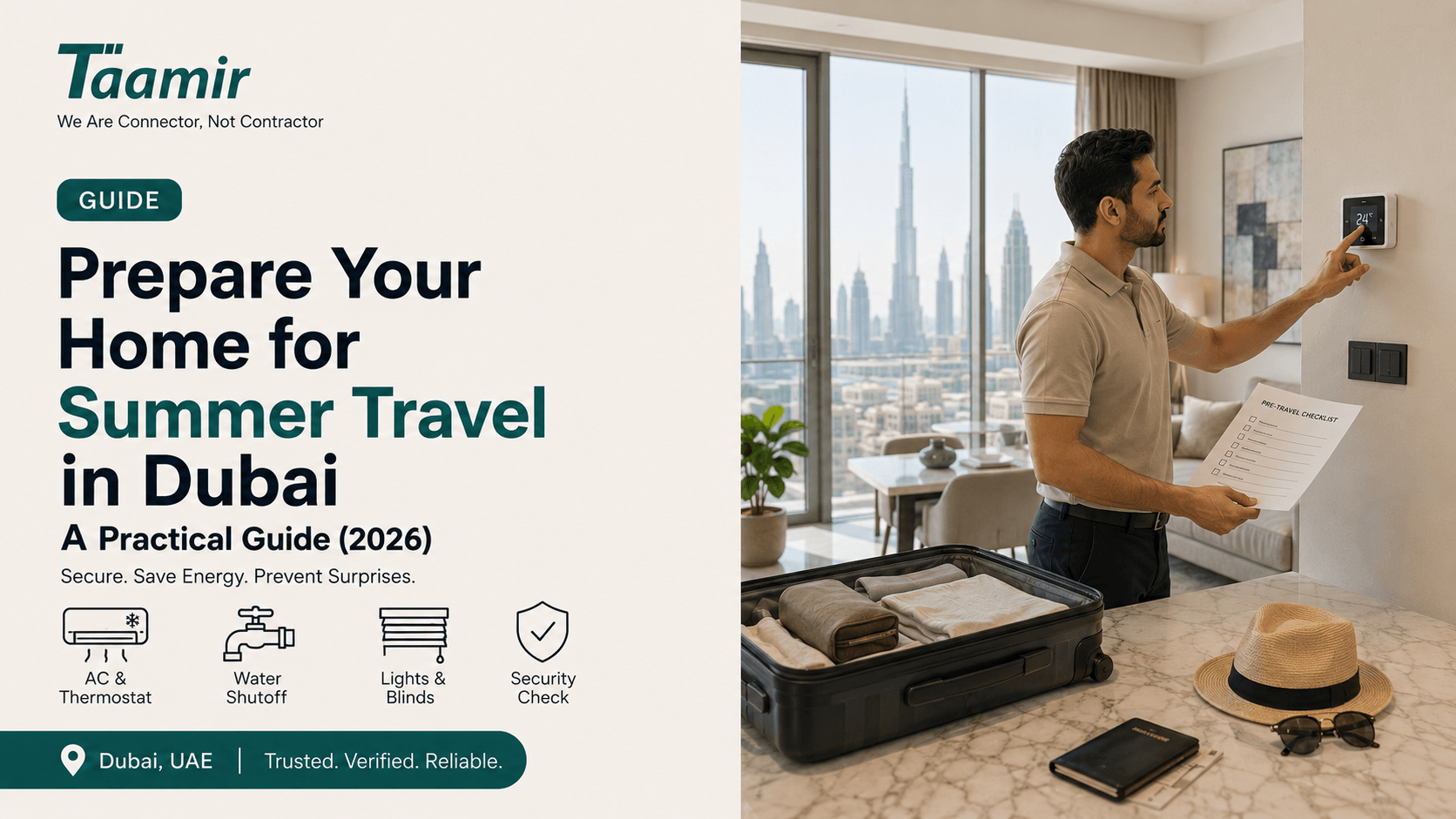
Leaving Dubai for the Summer? How to Prepare Your Home (2026)
Before you fly out of Dubai for the summer, four things protect your home more than everything else combined: don't switch the AC fully off (set it to 26–28°C on auto, or schedule short daily runs), shut the main water valve, switch off the water heater, and clear the kitchen and drains so pests find nothing to move in for. An hour of preparation is the difference between coming home to a fresh flat and coming home to a disaster.
Every July, Dubai empties out — school's done, and half the city heads somewhere cooler for two weeks to two months. Your home, unfortunately, stays behind in the 45°C heat, and an empty, sealed-up property behaves very differently from a lived-in one. The good news is that everything below fits into your last couple of days before departure, and most of it — like a quick pre-travel AC service — is a small effort that pays for itself many times over.
The AC question: off, on, or scheduled?
The one decision everyone debates. Switching the AC off entirely does save energy — but DEWA itself has warned the trade-off can be "fungus formation, bad smells, and damage to paint, furniture and electrical/electronic equipment" from the heat and humidity that build up inside. Residents have returned from a single week away to mould on walls and ceilings; after a month, people have had to throw out furniture. In a Dubai summer, fully off is the expensive option.
The smart middle ground:
Set 26–28°C on the auto setting — warm enough to keep the bill sane, cool enough to keep humidity from settling into fabrics, wood, and walls. DEWA's own guidance for an empty home is 28°C with the fan on auto. If your thermostat has a dry mode, it's ideal: it strips humidity without over-cooling.
Or schedule short daily runs if you have a programmable or smart thermostat — a few hours a day keeps air moving and moisture out.
Villa with multiple units? Running one upstairs unit with internal doors open circulates cool air down through the house.
Close curtains and blinds before you leave — it cuts solar heat gain dramatically and lightens the AC's job.
Prep the system: clean the filter and make sure the condensate drain is clear — ideally with a quick professional service that flushes the drain lines, so the unit doesn't leak or fail with nobody home. If the AC was already struggling before your trip, fix it now, not in September: our guide to why an AC isn't cooling covers the usual suspects.
Monitor from abroad: DEWA's app has an Away Mode that lets you watch your consumption while travelling — a spike or a flatline both tell you something's wrong at home.
What happens inside a sealed, unconditioned flat in August is exactly how mould takes hold — our companion guide to mould in Dubai homes covers that side in full.
Shut the water at the source
This is the cheapest insurance in the whole checklist. Find your main internal shut-off valve and close it. A pinhole leak or a failed washing-machine hose that would be a mop-up job on a Tuesday evening becomes, over three unattended weeks, a flooded apartment and your neighbour's ceiling. Everything inside the property past the meter is the owner's responsibility, and DEWA itself urges residents to keep internal connections checked — so before you go, glance under sinks and behind the washing machine, and get any drip fixed by a professional rather than leaving it to develop in private.
Switch off the water heater
With the water off, switch the water heaters off too. DEWA's conservation guidance recommends switching electric water heaters off during summer anyway — it saves up to 50% on water-heating energy — and an empty home has no reason to keep tanks of water hot for weeks. Two switches, ten seconds, real money.
Kitchen, fridge, and bins
Heat plus organic matter is the whole problem here. Clear out everything perishable, take the bins out as the genuinely last thing you do, and run and empty the dishwasher, leaving its door ajar. For a trip of a couple of weeks, leave the fridge running as normal, just emptied of anything that can turn. For a very long absence, some households empty and switch the fridge off entirely — if you do, prop the door open, or you'll return to a science experiment.
Don't come home to new roommates
A quiet, warm, empty home is prime real estate for pests, and prevention is entirely about removing the invitation:
Deep-clean food traces — crumbs, grease behind the hob, pet-food residue.
Seal everything edible in airtight containers; nothing in open packets.
Mind the drains. Water in P-traps evaporates in the summer heat, opening a highway for cockroaches from the drainage system. Pour water down every drain the day you leave, and cover shower and floor drains.
For long absences, a pre-travel pest treatment is cheap peace of mind — compare verified pest-control professionals and book it for your final week.
Power, security, and eyes on the house
Unplug non-essential electronics — it removes surge risk and phantom power draw — but leave the router running if anything smart depends on it. This is where a small smart-home setup earns its keep: smart plugs, a leak sensor under the kitchen sink, a camera, and a smart AC controller mean your phone knows about a problem the day it happens, not the day you land. Leave a key with someone you trust and have them walk through once a week or two — a human airing the place out beats every gadget. And tell building security or your community management you're away; they notice things.
The 48-hour countdown
Book or complete the AC service; set 26–28°C auto or a daily schedule
Close all curtains and blinds
Shut the main water valve; switch off water heaters
Clear perishables; run the dishwasher, door ajar; bins out last
Water every drain and cover the floor drains
Deep-clean food areas; seal dry goods
Unplug non-essentials; confirm smart devices and router are live
Key with a trusted person; notify building security
Photograph the meters and the main rooms
Lock up, and check DEWA Away Mode once you've landed
Set up your return
Book a professional cleaning for the day before you're back and you'll walk into a home that smells like someone lives there. If the AC smells musty on restart after weeks of light duty, that's coil and drain buildup talking — book a service rather than living with it. Ten minutes of scheduling from the beach, and the homecoming takes care of itself.
Frequently Asked Questions
Should I leave the AC on or off when leaving Dubai for the summer?
Not fully off. DEWA itself notes that switching off entirely risks fungus, bad smells, and damage to paint, furniture, and electronics from heat and humidity. Set 26–28°C on auto (DEWA suggests 28°C), use dry mode if you have it, or schedule short daily runs on a smart thermostat.
What temperature should I set the AC to while I'm away?
26–28°C on the auto setting is the expert consensus for an empty Dubai home — warm enough to control the bill, cool enough to keep humidity below the level where mould takes hold. Close the curtains and it works even less.
Should I turn off the water at the mains before travelling?
Yes — it's the single cheapest protection on the list. A minor leak left running for weeks can flood your home and damage the apartment below, and everything past the meter is on you, not DEWA. Shut the main internal valve and switch off the water heaters.
Can I leave my fridge running for a month?
Yes — a fridge is designed for continuous running; just empty it of anything perishable. For very long absences you can empty and switch it off instead, but always prop the door open if you do.
Is a pest-control treatment before travelling worth it?
For absences beyond a couple of weeks, usually yes. An empty, warm home with dried-out drain traps is an open invitation; a pre-travel treatment plus watered, covered drains and sealed food closes it.
Fly out with the house handled
Most of this list is an hour of your own time; the rest is a couple of bookings. Find and compare verified professionals on Taamir for the pre-travel AC service, pest treatment, or return-day clean — review their quality signals and connect directly, with no commission and no hidden charges.