AC Not Cooling in Dubai? Causes and Fixes
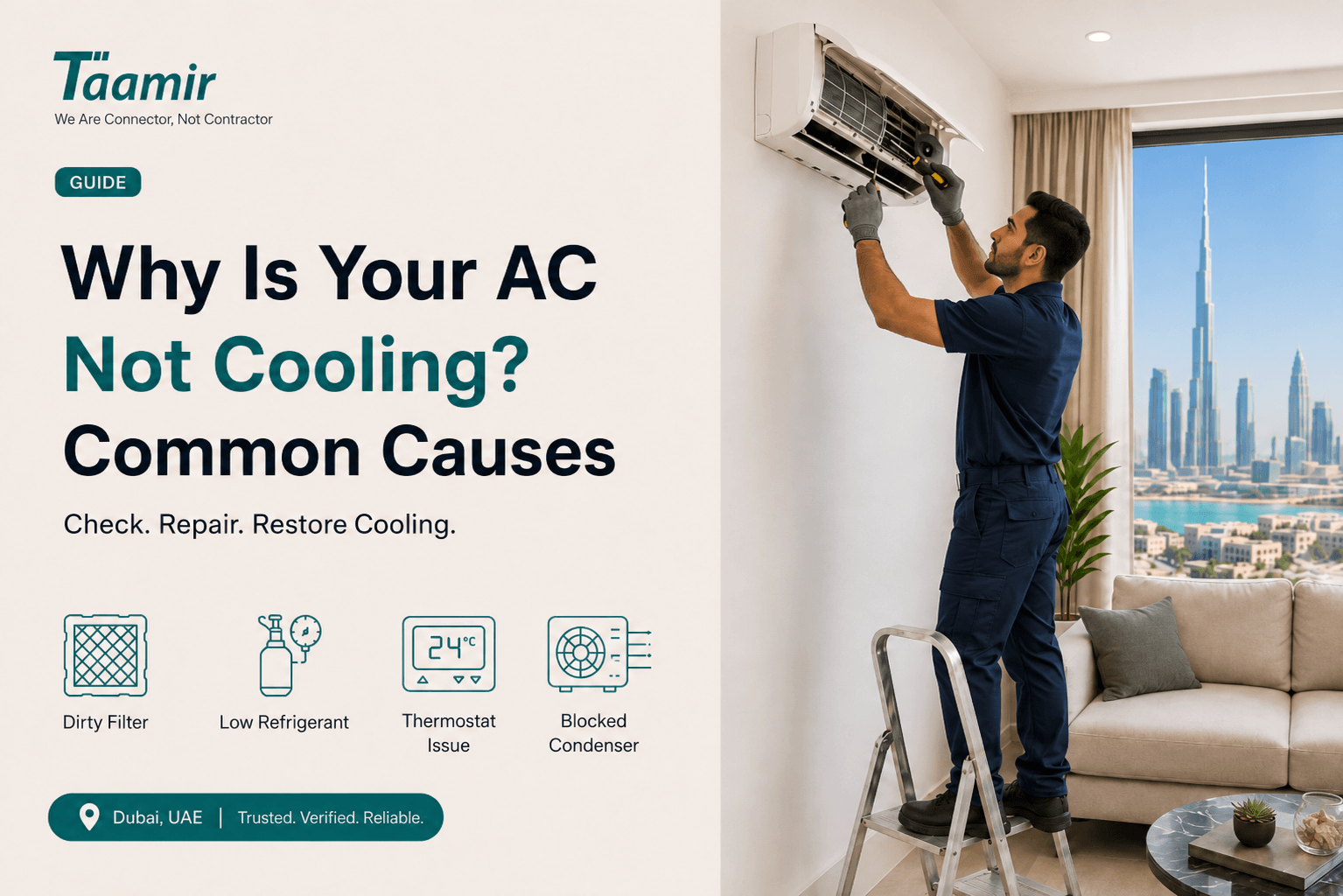
AC Not Cooling in Dubai? Causes and Fixes (2026)
If your AC is running but not cooling, the most common cause in Dubai is a clogged air filter — service companies report it behind roughly four in ten summer callouts. Other frequent culprits are a dust-coated outdoor condenser, a frozen evaporator coil, low refrigerant from a leak, a thermostat fault, or — in many towers — a building-level district cooling issue. Some you can safely check yourself in ten minutes; others need a licensed technician.
This summer is a particularly bad one to lose cooling. Gulf News reports that forecasters see a strong chance of an El Niño-influenced season for the UAE, with longer stretches above 45°C and warmer nights that give systems no recovery time. From June to September a Dubai AC runs at close to maximum capacity for months on end — far beyond what most units were designed to sustain — so small problems that would pass unnoticed in February escalate into breakdowns in July. Here's how to work out what's wrong, what's safe to fix yourself, and when to stop and call a professional.
Why is my AC running but not cooling?
Work through the causes in order of likelihood — the cheap, simple explanations come first.
A clogged air filter
The single most common cause, and the one you can fix yourself in minutes. Dubai's fine desert dust loads filters far faster than milder climates, and a badly clogged filter can cut airflow dramatically — the unit runs, but barely any cooled air reaches the room, and the system strains against itself. Pull the filter out and hold it to the light: if you can't see through it, that's likely your answer. In summer, check filters monthly and clean or replace them every one to two months — not the three-month interval printed on the box for cooler countries.
A dust-coated outdoor condenser
Your condenser dumps indoor heat outside, and it can't do that through a blanket of dust. Fine particulate settles on the coil fins and acts like insulation — a partially blocked coil forces the system to work harder and can add a noticeable chunk to your DEWA bill while cooling gets worse. Check that nothing sits within about half a metre of the outdoor unit and gently clear away leaves and debris. The coil itself needs professional cleaning; bent fins and high-pressure water in the wrong hands cause more damage than the dust.
A frozen evaporator coil
Counterintuitive but common: restricted airflow or low refrigerant makes the indoor coil ice over, and a frozen coil can't cool anything. If you spot ice on the indoor unit or its pipes, switch the mode to fan only (compressor off) and let it thaw for a few hours. That gets you temporary relief — but ice is a symptom, not the disease. If it returns, the underlying cause needs a technician.
Low refrigerant from a leak
Refrigerant doesn't get "used up" — if it's low, it leaked, and Dubai's thermal stress on joints and coils makes leaks more common here. The signs: warm air from the vents, hissing sounds, ice on the pipes, and a system that runs constantly without reaching temperature. This is strictly a professional job: locating the leak, repairing it, and recharging to the correct level requires licensed handling. Anyone offering to simply "top up the gas" without finding the leak is selling you the same problem again in a month.
A thermostat fault
Sometimes the brain is the problem, not the body. Extreme heat can send thermostats out of calibration, and dying batteries cause erratic behaviour. Check the obvious first: cooling mode selected, temperature set below the current room reading, fan on auto, fresh batteries. If the thermostat misreads the room or drops its connection to the unit, replacement is inexpensive — and if you're upgrading anyway, a smart thermostat pays for itself in a Dubai summer by trimming run-time automatically.
A building-level district cooling issue
Uniquely relevant in Dubai: many towers don't have conventional split units at all — cooling arrives as chilled water through a district cooling or central chilled-water network. Cooling specialists told Gulf News that when a chiller or pump underperforms, an entire section of the building can lose cooling capacity at once — and nothing inside your apartment will fix it. Before booking a technician, ask a neighbour on your riser whether their flat is warm too, and check with building management. If it's a network issue, the fix — and the responsibility — sits with the building, not you.
What you can safely check yourself
A ten-minute triage before you spend a dirham:
Thermostat: cooling mode, set point 2–3°C below room temperature, fresh batteries.
Filter: pull it, inspect it, clean or replace if you can't see light through it.
Airflow: every vent open and unblocked by furniture or curtains.
Outdoor unit: clear space around it; nothing leaning on it; fan spinning.
Ice check: run 30 minutes, then look for frost on the indoor coil or pipes. If frozen, switch to fan-only and let it thaw.
Breaker: confirm the AC's circuit breaker hasn't tripped — if it trips repeatedly, stop there; that's an electrical fault that needs a professional, not a reset ritual. Our guide to why a fuse box keeps tripping covers what's usually behind it.
If cooling doesn't recover after the filter is clean, the coil has thawed, and the thermostat checks out — stop. Refrigerant, electrical components, and compressor work are not DIY territory in any climate, least of all this one.
When to call a professional — and what it costs
Call a licensed technician when the air stays warm despite a clean filter, when ice keeps returning, when you hear grinding or smell burning, when the unit water-leaks indoors, or when the breaker trips more than once. In 2026, a standard professional service visit in Dubai typically runs AED 120–300, a full chemical/deep clean of a unit around AED 300–500, and an annual maintenance contract (AMC) for a villa roughly AED 1,000–3,000 per year — which sounds like money until you price a mid-August emergency callout and a failed compressor against it. Unserviced units also quietly burn 20–30% more electricity, so neglect shows up on your DEWA bill long before the breakdown.
This is exactly the situation where comparing beats guessing: on Taamir you can find and compare verified AC professionals in one place — check their quality signals, connect directly, and get itemised pricing — with no commission fees inflating the quote.
How to stop this happening every summer
The pattern behind almost every July breakdown is a skipped spring service. Dubai systems need professional attention at least once a year, ideally in March–April before peak load arrives, with a deeper chemical clean every 6–12 months and monthly filter checks through summer. Keep the thermostat around 24°C — every degree colder adds meaningful load and cost for marginal comfort. And if your unit is limping through its second summer of warnings, price a planned replacement in the mild months against an emergency one in August; the calm version is always cheaper.
Frequently Asked Questions
Why is my AC blowing air but not cold air?
Most often a clogged filter or dust-coated condenser restricting the system's ability to move heat; other causes are a frozen coil, low refrigerant from a leak, or a failing thermostat. Start with the filter — it's the cause in roughly four out of ten summer callouts.
How often should I change AC filters in a Dubai summer?
Check monthly and clean or replace every one to two months during summer. Dubai's dust load is far heavier than the climates most manufacturer schedules assume, so the "every three months" guidance on the packaging doesn't apply here.
How much does AC repair or servicing cost in Dubai?
A standard service visit typically costs AED 120–300, a chemical deep clean around AED 300–500 per unit, and an annual maintenance contract for a villa roughly AED 1,000–3,000. Emergency summer callouts and major repairs like compressor replacement cost far more, which is why the spring service pays for itself.
My whole building feels warm — is it my AC or the building?
In many Dubai towers, cooling is delivered through district cooling or a central chilled-water network. If neighbouring apartments are warm too, the issue is likely at building level — a chiller or pump problem — and building management, not a private technician, needs to resolve it.
Is it safe to top up AC refrigerant myself?
No. Refrigerant handling requires a licensed professional, and low refrigerant always means a leak that must be found and repaired first. A "gas top-up" without a leak repair is a temporary patch that fails again within weeks.
What temperature should I set my AC to in a Dubai summer?
Around 24°C is the widely recommended balance of comfort and efficiency. Setting it dramatically lower doesn't cool the room faster — it just keeps the compressor working longer and raises your DEWA bill.
Get your cooling sorted before the peak
Don't wait for the hottest week of the year to find out your AC was warning you all along. Find and compare verified AC maintenance and repair professionals on Taamir, review their quality signals, and connect directly — or browse the full verified provider directory for any other trade your home needs this summer.