What Is Snagging? A Dubai Homeowner's Guide (2026)
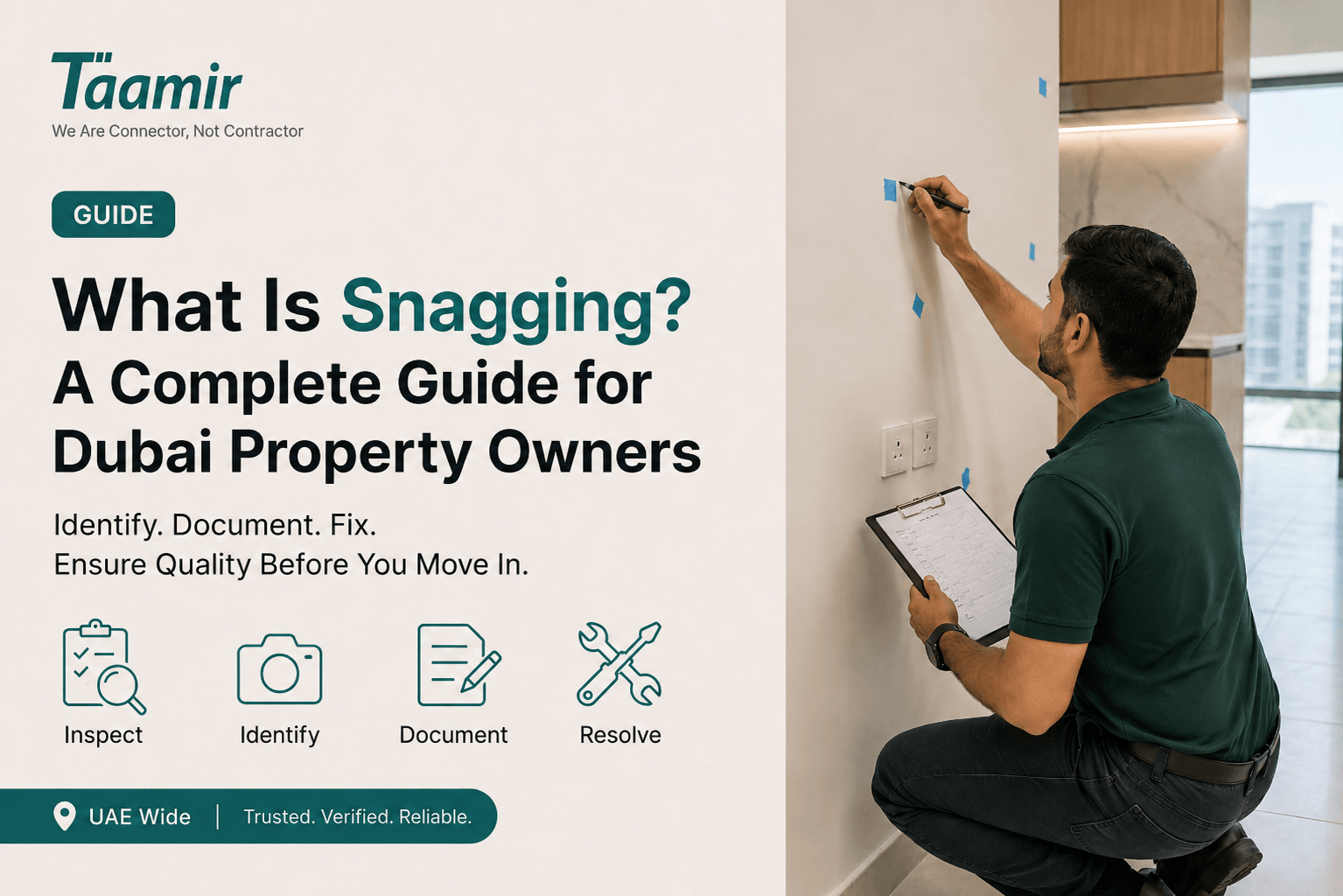
What Is Snagging? A Dubai Homeowner's Guide (2026)
Snagging is a professional inspection of a newly built or newly renovated property that documents every defect, unfinished item, and deviation from the agreed specification before you sign for it. In Dubai's off-plan market it's your single best moment of leverage: once you accept handover, the burden of chasing fixes shifts largely onto you. This guide explains what snagging covers, what it costs in 2026, the legal protection behind it, and exactly when to do it.
If you've waited two or three years for an off-plan apartment or villa, the handover notice feels like the finish line. It isn't — it's the one point where the developer is still contractually on the hook to fix things at their cost, and where a couple of hours of scrutiny can save you tens of thousands of dirhams. A premium developer and a high price tag don't guarantee flawless construction; professional inspectors routinely find dozens of defects in units that look perfect at a glance.
What is a snagging inspection, exactly?
A snagging inspection is a systematic, room-by-room check of a property against the specification promised in your Sales and Purchase Agreement (SPA) and sales brochure. Every flaw — from a hairline paint run to a failed waterproofing membrane — is recorded in a snag list: a formal register of defects with photographs, locations, and descriptions that goes to the developer for rectification. The term comes from British construction and is now standard across the UAE property market.
A thorough inspection covers every element of the unit, including:
Finishes — paint coverage, tile alignment and hollow tiles, grouting, silicone sealant, skirting, and joinery.
Plumbing — water pressure, drainage flow, leaks under sinks, and connections.
Electrical systems — every outlet and switch, earthing, the distribution board, and smoke-detector commissioning.
Air conditioning — cooling performance at each unit, drainage, and thermostat function. (A unit that runs but doesn't cool properly is a classic snag — see our guide to why an AC isn't cooling.)
Waterproofing — wet areas, balconies, and any sign of water ingress, often checked with a moisture meter.
Doors and windows — alignment and operation, locks, and seals against dust and water.
Countertops, cabinetry, and fixtures — matching the SPA specification, not a cheaper substitute.
Professional inspectors bring tools most buyers don't have: thermal imaging cameras to spot moisture behind walls, laser levels to check whether floors are truly level, and moisture meters for walls and ceilings.
Apartment vs villa — and how many defects to expect
The principles are identical, but villas carry a larger inspection scope: exterior walls and façade, the garden and boundary walls, a private pool, the garage, roof spaces, and multiple floors all need checking, which is why villa inspections cost more and take longer.
The defect counts surprise most first-time buyers. A new apartment commonly returns dozens of snags — frequently more than a hundred — while large villas can run into the hundreds. These aren't signs of a bad developer; they're the normal output of large-scale construction, and every one of them is the developer's responsibility to fix if it's documented before you sign.
When should you do it? The Dubai handover sequence
Timing is everything, because your leverage drops the moment you sign the handover acceptance form. The process, regulated by the Dubai Land Department (DLD) and RERA, runs in a defined order:
Completion notice. The developer confirms construction is finished and the building completion certificate is issued, and gives you a limited window — often around 30 days — to complete handover formalities.
First inspection (snagging). You or your inspector document every defect while the unit is still legally the developer's responsibility. Most developers allow one or two inspection visits.
Developer rectification. The developer works through your snag list and repairs the reported items.
Re-inspection. A second visit confirms each item is genuinely fixed, not just marked closed.
Sign only when clear. Don't sign the handover certificate until all material defects are resolved, or you have a written rectification plan with fixed dates. Verbal promises carry no weight — keep everything in email.
The single most expensive mistake is rushing this to get the keys sooner. Signing first and complaining later means accepting the property in its current condition.
Your legal protection: the Defect Liability Period
Snagging isn't legally required in Dubai, but it's how you make use of a protection that is. Under Article 40 of Dubai Law No. 6 of 2019 on jointly owned property, developers are liable for structural defects for 10 years from the date of the completion certificate, and for defective installations — the mechanical, electrical, and plumbing systems — for one year from the date of handover.
Snagging isn't only for off-plan handovers
The same discipline applies at the end of a renovation. A well-structured renovation contract includes a snagging period after practical completion — typically four to six weeks — during which your contractor returns to fix anything that doesn't meet the agreed specification, and it's standard to hold back a small retention (commonly around 2–3% of the contract value) until those items are closed. If you're renovating rather than buying new, budget for a proper handover check the same way — and see our home renovation cost guide for how to structure the contract and contingency.
What happens after the inspection
Once the inspection is done, you receive a detailed report — organised room by room, with photographs of each defect — and a snag list formatted for the developer to act on. You submit it in writing, the developer rectifies, and you re-inspect to confirm. Only when the material items are genuinely closed (or contractually scheduled) do you accept handover. A good report doesn't just list problems; it gives you the documented leverage to insist they're fixed.
This is exactly where an independent, verified professional earns their fee: someone whose only job is to protect your interest, with no relationship to the developer. On Taamir you can find and compare verified inspection and home professionals, review their quality signals, and connect directly — with clear information and no commission fees.
Frequently Asked Questions
Is snagging mandatory in Dubai?
No. No regulation requires a buyer to conduct a snagging inspection. But signing the handover certificate without one means accepting the property as-is, so it's strongly recommended — especially for first-time buyers and higher-value properties.
Who pays for snagging — the buyer or the developer?
The buyer pays for the inspection. The developer is then legally responsible for repairing every verified defect at no cost, provided the defects are documented and reported before you sign the handover acceptance form.
How long does a snagging inspection take?
Around one to two hours for a one-bedroom apartment, and several hours for a larger villa. Rushing it is the most common mistake — a proper inspection is deliberately methodical.
What is the Defect Liability Period in Dubai?
Under Dubai Law No. 6 of 2019, developers are liable for defective installations (MEP and finishing) for one year from handover, and for structural defects for ten years from the completion certificate. Report any defect in writing within the relevant window to have it fixed at the developer's cost.
How many defects does a typical new Dubai property have?
More than most buyers expect. New apartments commonly return dozens of snags, often over a hundred, and large villas can run into the hundreds. This is normal for large-scale construction — the point of snagging is to catch them while the developer is still liable.
Can I do the snagging inspection myself?
You can, but professional inspectors use thermal cameras, laser levels, and moisture meters to find issues that aren't visible to the eye — hidden moisture, uneven floors, sealing failures. For a property worth well over a million dirhams, an independent inspection is a small, high-return safeguard.
Protect your handover before you sign
A snagging inspection is a few hours and a modest fee standing between you and defects that become your problem the moment you accept the keys. Find and compare verified inspection and home-service professionals on Taamir, review their quality signals, and connect directly — no commission, no hidden charges.
This guide is general information, not legal advice. Defect-liability rules and handover procedures can vary by developer and change over time — confirm your position with the Dubai Land Department, RERA, or a qualified property lawyer.