Types of Pest Control: Methods & Which One You Need (Dubai, 2026)
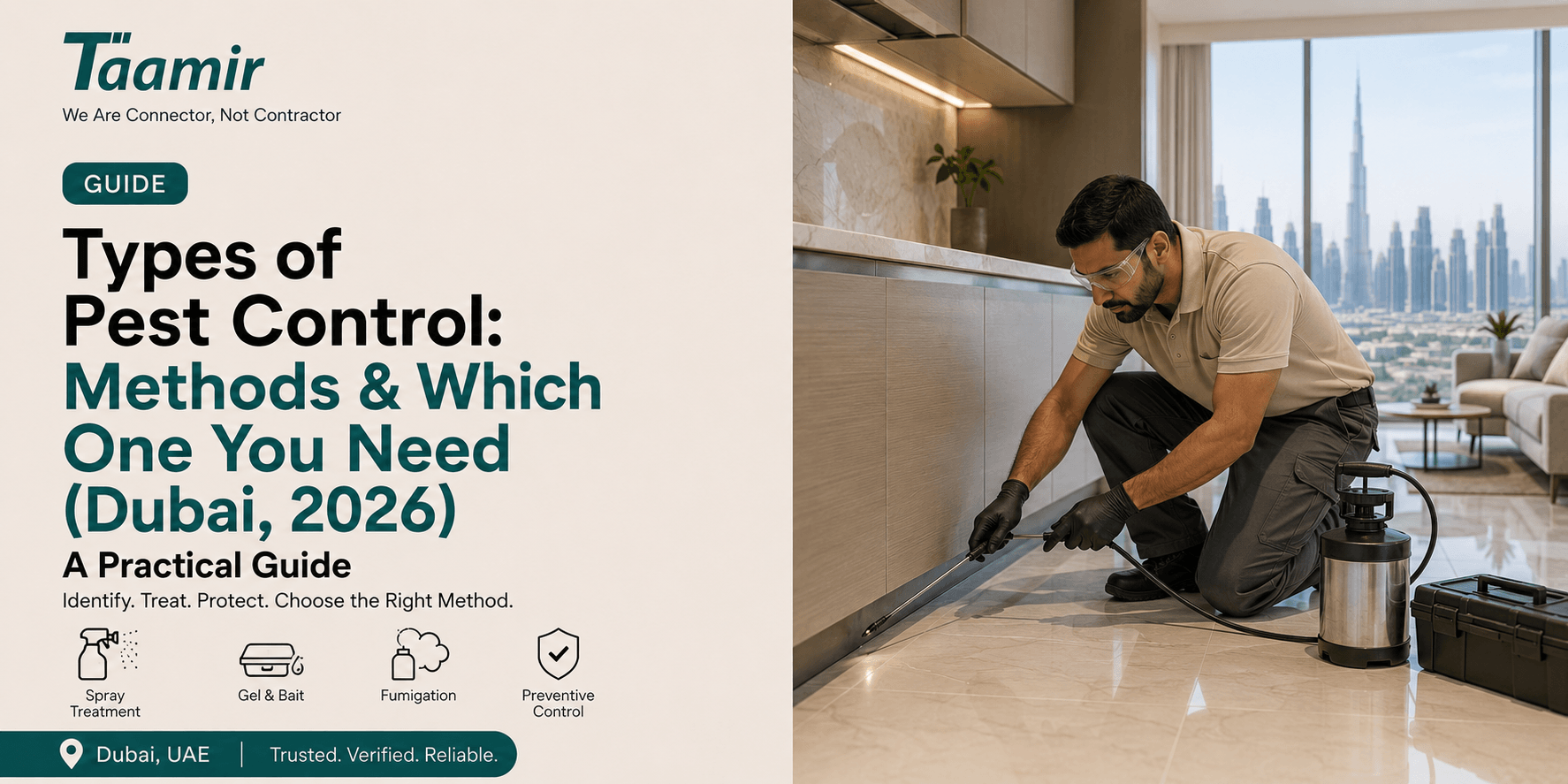
Types of Pest Control: Methods & Which One You Need (Dubai, 2026)
Pest control falls into a few main types — chemical, biological, physical, and the integrated approach (IPM) that combines them — plus specific techniques like gel baiting, fumigation, heat treatment, and exclusion. The right one depends entirely on the pest and the situation, which is why professionals identify the species first and match the method to it rather than reaching for a single spray for everything.
"Pest control" sounds like one service, but it's really a toolkit — and knowing what's in it helps you understand what a professional is proposing, ask better questions, and recognise a thorough approach from a quick one. This guide walks through every main type of pest control, the specific treatments within each, and which method suits which pest — so that whether you're comparing quotes or just trying to understand your options, you can compare verified pest-control professionals on Taamir knowing exactly what to look for.
The main categories of pest control
Almost every treatment you'll encounter belongs to one of these families.
Chemical control
The most widely used approach, and for good reason: applied correctly by a trained professional, it delivers fast, reliable results. Chemical control uses registered pesticides in several forms — residual sprays for surfaces, gel baits for specific insects, dusts and granules for perimeters and voids, and fumigants for whole-structure problems. The key is precision: the right product, in the right place, at the right concentration. A skilled professional uses far less chemical, far more accurately, than a panicked homeowner with a supermarket can.
Biological control
This uses nature against the pest — natural predators, parasites, or microbial agents that suppress a pest population with minimal chemical input. It's more common in gardens, agriculture, and large-scale settings than in a typical apartment, but it's a core part of the modern, lower-toxicity toolkit and often forms one layer of a broader plan.
Physical and mechanical control
Non-chemical, and often the most underrated. This covers traps, bait stations, physical removal of nests, and exclusion — sealing the gaps and entry points that let pests in, and fitting barriers and screens. For many problems, removing the entry point and the attraction does more lasting good than any treatment, which is why a good professional treats and advises on exclusion rather than only spraying.
Cultural control
The quiet foundation under everything else: modifying the environment so pests can't thrive. Proper waste management, food stored in sealed containers, fixing moisture and leaks, and general sanitation remove the food, water, and shelter pests need. It's mostly prevention, it's largely in your hands, and it's what makes every other method work better.
Integrated Pest Management (IPM) — the modern standard
IPM isn't a separate technique; it's the framework that combines all of the above intelligently. Rather than defaulting to chemicals, IPM starts with inspection and identification, uses prevention and physical methods first, applies targeted treatment where needed, and monitors the result — using the least intervention that solves the problem. It's the approach serious professionals work to, and it's the standard set at the top: Dubai Municipality's Public Health Pest Control Section runs integrated pest management programmes and maintains the emirate's list of approved pest control companies, approving the products used and certifying technicians. When you choose a professional working to IPM principles, you're choosing diagnosis over guesswork.
The specific treatments — and when each is used
Within those categories, these are the treatments you'll actually see named on a quote:
Gel baiting — precise dots of bait at harborage points for cockroaches and ants. The bait is carried back to the colony, so it clears the ones you never see. The opposite of blanket spraying, and far more effective for these species.
Residual spraying — a treated surface layer that keeps working over time, used along skirtings, entry routes, and perimeters.
Fumigation — sealing a space and introducing a gas to reach pests throughout an entire structure. Reserved for serious, widespread problems and specialist situations, and strictly professional-only.
Fogging / ULV misting — a fine mist that treats large volumes of air and space, often used for flying insects like mosquitoes and flies, and for large areas.
Heat treatment — raising a room's temperature to a level pests can't survive, used especially for bed bugs, where it reaches into fabric and furniture that sprays can't.
Baiting and trapping stations — for rodents, monitored stations placed along their routes, combined with exclusion.
Exclusion and proofing — sealing entry points, fitting screens and barriers. The physical work that stops the next infestation before it starts.
Natural treatments — options like diatomaceous earth for light activity; useful at the margins of prevention, though not a substitute for proper treatment of an established problem.
Matching the method to the pest
The single most important idea in pest control: the treatment depends on the pest. Identifying the species correctly is what determines the right method — and getting it wrong wastes time and money. A quick guide to how the common household pests are typically approached:
Cockroaches — gel baiting at harborage points, paired with sanitation and exclusion. Blanket spraying tends to scatter the colony, so a targeted, IPM-style approach works better.
Ants — species identification first, then targeted baiting and removing the trail's food and moisture source. Our guide to getting rid of tiny ants in Dubai walks through the specifics.
Bed bugs — among the most stubborn: usually a combination of heat treatment and targeted application, with follow-up visits, because eggs survive a single pass.
Termites — a specialist category of its own, using soil treatments, baiting systems, and physical barriers; early detection through inspection matters enormously.
Rodents (rats and mice) — monitored baiting and trapping stations along their routes, combined with sealing the gaps they enter through.
Flying insects (mosquitoes, flies) — source reduction first (removing standing water and breeding sites), supported by fogging or misting for the adult population.
Because the method hinges on correct identification, the most valuable thing a professional does often happens before any treatment: working out exactly what you're dealing with.
DIY or professional — which type fits your situation?
Both have their place, and knowing the line saves you money on one hand and a recurring problem on the other. Light prevention is squarely a homeowner job: sanitation, sealing obvious entry points, keeping food sealed, watering rarely-used drains, and light bait or trap use for the occasional stray. Not every sighting needs a professional call-out.
A professional is the right call when the problem is established, recurring, or hard to reach — anything involving fumigation, heat treatment, termites, rodents in the structure, or a colony you're seeing by daylight. Professionals bring correct species identification, the right method for that pest, and — importantly — registered products applied safely by certified technicians. That safety point matters: professional treatment is built around approved products and proper handling, which is exactly why choosing a qualified, approved provider is worth doing.
How Taamir fits in
Because the right type of pest control depends so heavily on getting the diagnosis and method right, choosing the professional carefully matters more here than almost anywhere. On Taamir you can compare verified pest-control professionals side by side — every listed provider passes Taamir's verification before you ever see them — review their quality signals, and connect directly. For a pest problem specifically, three things worth confirming with any candidate: whether they identify the species and work to IPM principles rather than simply spraying everything, whether they are Dubai Municipality-approved and use approved products (the safety foundation for any treatment at home), and whether a follow-up visit is included to break the breeding cycle on stubborn pests like bed bugs and cockroaches. Because Taamir adds no commission, the quote reflects the work — and once you've found a professional you trust, rebooking them for prevention or a seasonal check takes minutes.
Frequently Asked Questions
What are the main types of pest control?
The main categories are chemical (registered pesticides in sprays, gels, dusts, and fumigants), biological (natural predators and microbial agents), physical or mechanical (traps, barriers, and exclusion), and cultural (sanitation and environment changes). Integrated Pest Management, or IPM, is the framework that combines them — starting with inspection and prevention and using targeted treatment only where needed.
What is Integrated Pest Management (IPM)?
IPM is the modern professional standard: rather than defaulting to chemicals, it inspects and identifies the pest first, uses prevention and physical methods, applies targeted treatment where necessary, and monitors the result — the least intervention that solves the problem. It's the approach Dubai Municipality's Public Health Pest Control Section works to, and the one to look for in a provider.
Which pest control method is best for cockroaches?
Gel baiting at harborage points, combined with sanitation and sealing entry points. The bait is carried back to the colony, clearing the ones you can't see — which is why it outperforms blanket spraying, and why a targeted, IPM-style approach is the professional standard for cockroaches.
Is chemical or natural pest control safer?
Both are safe when done correctly — the key isn't chemical versus natural, it's proper identification, the right method, and correct application. Professional treatment is built around registered products handled by certified technicians, which is why choosing an approved provider matters more than choosing a category.
Do I need a professional, or can I handle it myself?
Light prevention — sanitation, sealing entry points, sealed food storage, the occasional trap — is a homeowner job, and not every sighting needs a call-out. A professional is the right call for anything established, recurring, or hard to reach: fumigation, heat treatment, termites, rodents in the structure, or a colony visible by daylight.
Choose the right approach, and the right professional
The best type of pest control is the one matched to your specific pest by someone who identified it correctly first. Find and compare verified pest-control professionals on Taamir, review their quality signals, and connect directly.