How Often Should You Service Your AC in Dubai? (2026)
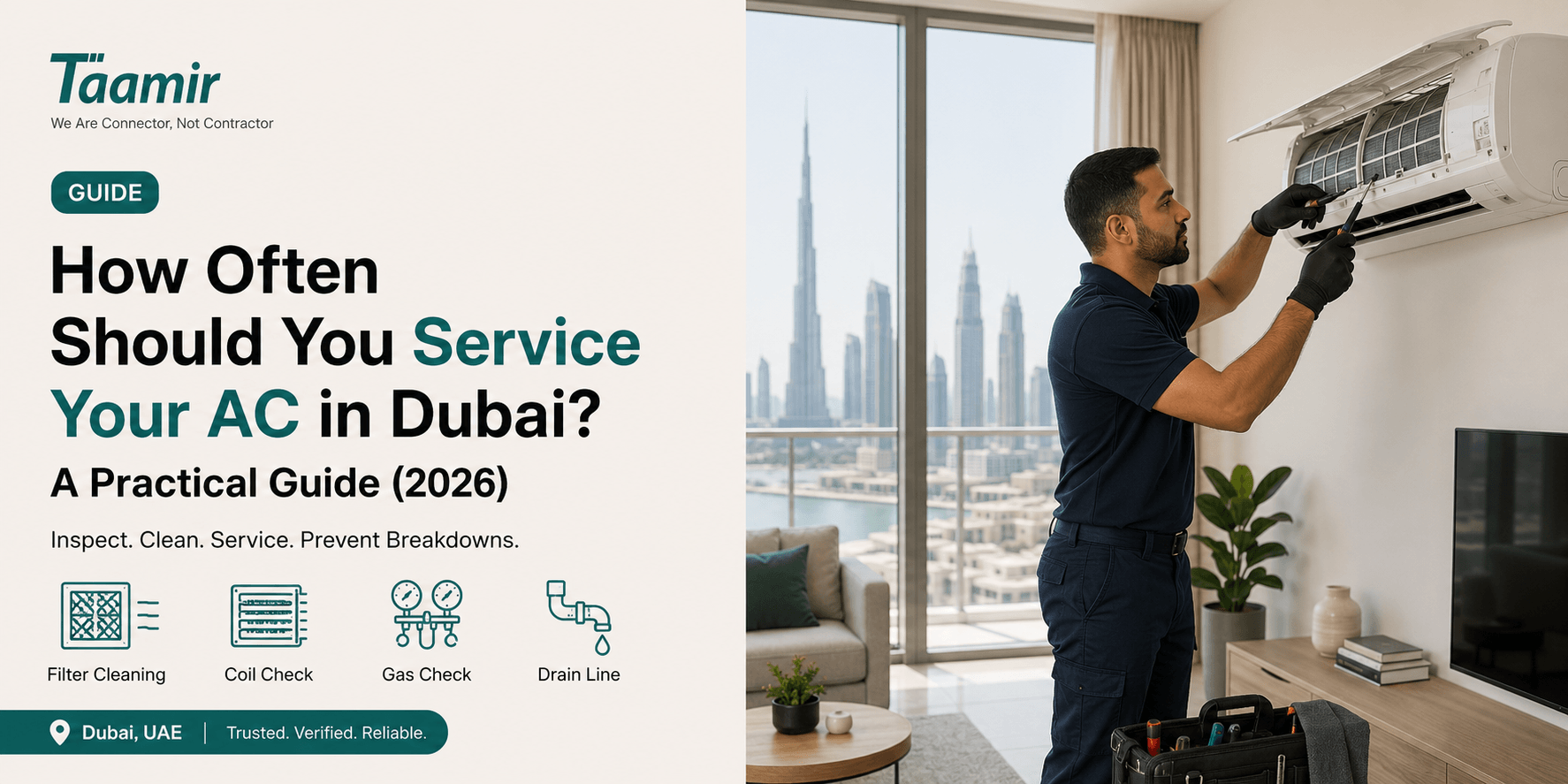
How Often Should You Service Your AC in Dubai? (2026)
In Dubai's climate, your AC needs a full professional service at least once a year — ideally in March or April, before peak load arrives. On top of that, check and clean the filters monthly through summer, book a deep chemical clean every 6–12 months, and give villas or heavily used systems a basic check every three to four months. That schedule is more frequent than the manufacturer's manual suggests, and there's a reason for it.
Most AC manuals are written for climates where the system rests for half the year. In Dubai it runs close to continuously for eight or nine months, in fine desert dust, through summers that regularly pass 45°C. Under that load, "service it when something feels wrong" is how a July breakdown happens — and mid-summer is the most expensive, slowest time to get one fixed. Here's the full servicing schedule that keeps a Dubai AC efficient and reliable, what each service actually involves, and the earliest signs you shouldn't wait.
Your Dubai AC service schedule at a glance
Monthly in summer: check the filters, and clean or replace them — DEWA's official guidance is to clean AC filters at least once a month during summer, because clogged filters block airflow and significantly reduce efficiency.
Every 3–4 months: a basic professional check for villas, large homes, or any system running hard — filters, drain line, thermostat, and general performance.
Every 6–12 months: a deep or chemical clean of the indoor unit, where the coils and blower are properly washed of the grime a surface clean can't reach.
Once a year, in March–April: the full professional service — coils, refrigerant pressure, drainage, electrical connections, and the outdoor condenser — timed before summer so problems are caught while the weather is still forgiving.
Around the 10-year mark: plan for replacement. DEWA puts the optimal lifetime of an AC at ten years, and notes that swapping an older unit for a high-efficiency ESMA 4- or 5-star model can cut cooling consumption by up to 25%.
If your building uses district cooling, the chilled water arrives centrally, but the fan-coil units inside your apartment still have filters and coils of their own — they need the same filter and cleaning routine, even though there's no outdoor condenser to worry about.
Why Dubai ACs need more servicing than the manual says
Three things make Dubai exceptionally hard on cooling systems. Dust is the big one: fine desert particulate loads filters and coats coils far faster than in milder climates, and a dust-blanketed coil works like insulation on the very component that's supposed to shed heat. Run-hours are the second: a Dubai system can log more compressor hours in one summer than a European unit does in several years, so wear arrives early. Humidity is the third: constant condensation feeds mould on coils and algae in drain lines, which is where musty smells and indoor water leaks begin.
Neglect shows up on your bill before it shows up as a breakdown — service companies consistently report that poorly maintained units burn roughly 20–30% more electricity for the same cooling. Regular servicing isn't an expense on top of your DEWA bill; it's usually the cheapest thing on it.
What a professional AC service actually includes
Not all "servicing" is the same job, so it's worth knowing what you're booking:
A basic service visit covers filter cleaning, drain-line flushing, thermostat checks, and a performance inspection — quick, and typically priced around AED 120–300 per visit in 2026.
A chemical or deep clean strips the indoor coil, blower, and drain tray back to clean metal, restoring airflow and cooling performance; expect roughly AED 300–500 per unit, once or twice a year depending on use.
Duct cleaning is a separate, less frequent job — worth doing when vents show dust build-up, smells linger, or after renovation work.
Treat these figures as market ranges rather than quotes, and always ask a provider exactly what their "service" includes — the difference between a filter rinse and a proper chemical clean is the difference between cosmetic and real maintenance.
The best time of year to book
March–April is the sweet spot: technicians have availability, any faults found can be fixed before the system faces real load, and you head into summer with clean coils and verified refrigerant pressure. The worst time to discover a problem is August, when demand peaks, response times stretch, and you're living without cooling in the meantime. If you want a second touchpoint, a lighter check in October — after the system's hardest months — sets you up for the mild season and catches any summer wear early.
AMC or pay-per-visit?
An annual maintenance contract (AMC) bundles scheduled visits with priority callouts, and in 2026 a villa AMC typically runs in the region of AED 1,000–3,000 per year. It tends to make sense for villas and homes with three or more units, where a single emergency repair can cost more than the contract, and where priority response in August has real value. For a small apartment with one or two lightly used units, paying per visit is often the more economical route. If you do take an AMC, check three things before signing: how many scheduled visits it includes, whether a chemical clean is part of the package or an extra, and what the response-time commitment is for emergency callouts — comparing those inclusions across verified providers side by side is exactly how to avoid the thin contracts.
Signs your AC needs service sooner
Don't wait for the schedule if you notice any of these:
The AC runs but the room stays warm — the classic summer complaint, with several possible causes; our guide to why an AC isn't cooling walks through them in order.
Musty or unpleasant smells from the vents — usually mould on the coil or a fouled drain line.
Water dripping from the indoor unit — a blocked drain, and a fixable one before it stains the ceiling.
A noticeably higher DEWA bill with no change in habits — the system is working harder than it should.
Grinding, rattling, or hissing sounds, or the unit tripping the breaker — electrical or mechanical faults; if the breaker trips repeatedly, see why a fuse box keeps tripping and call a professional rather than resetting it endlessly.
Short cycling — switching on and off in quick bursts instead of running steadily.
What you can do between services
A few habits stretch the time between professional visits and keep bills down. Keep filters clean — the single highest-impact task, and safely a DIY one. Keep half a metre clear around the outdoor condenser and gently remove leaves and debris. Set the thermostat to 24°C or higher: per DEWA, every degree you raise the set point saves up to 5% on cooling consumption, and a smart thermostat automates the discipline. Replace thermostat batteries yearly, and glance at the drain outlet occasionally for steady dripping — a sign the line needs flushing.
Know where the line is, though: refrigerant, electrical components, and compressor work are strictly for licensed technicians. A "gas top-up" without a leak repair, or DIY wiring, creates bigger problems than it solves.
Keeping it simple with the right professional
The pattern behind almost every mid-summer AC emergency is a skipped spring service. Put the annual service in your calendar for March, keep up the monthly filter habit through summer, and the rest is largely handled. When you're ready to book, find and compare verified AC professionals on Taamir — review their quality signals, see exactly what each service includes, and connect directly, with clear information and no commission fees.
Frequently Asked Questions
How often should AC filters be cleaned in Dubai?
Check them monthly and clean or replace them at least once a month during summer — that's DEWA's own guidance for Dubai conditions. The dust load here is far heavier than the climates most manufacturer schedules assume, so the "every three months" on the packaging doesn't apply.
What is a chemical clean, and how often does an AC need one?
A chemical clean is a deep wash of the indoor coil, blower, and drain tray that removes the grime a routine service can't. In Dubai, once every 6–12 months is typical — closer to every six months for systems running hard year-round, and it's the fix for musty smells and weak airflow.
What is the best month to service an AC in Dubai?
March or April. Technicians are more available, and any faults are found and fixed before the summer peak — which is exactly when you don't want to discover them. A lighter check in October, after the hardest months, is a sensible optional second touchpoint.
Is an AC maintenance contract (AMC) worth it in Dubai?
Usually yes for villas and homes with three or more units, where a villa AMC typically costs around AED 1,000–3,000 per year and a single emergency repair can exceed that. For a small apartment with one or two units, paying per visit is often cheaper. Check what visits, cleans, and response times the contract actually includes.
What happens if I skip AC servicing in Dubai?
Efficiency drops first — neglected units commonly use 20–30% more electricity — then reliability follows, typically failing during peak summer when repairs are slowest and most expensive. Skipped servicing also shortens the system's life, pulling forward the cost of full replacement.
I live in a district-cooling building — do I still need AC servicing?
Yes. District cooling supplies the chilled water, but the fan-coil units inside your apartment still have their own filters, coils, and drain lines that clog and foul like any other system. They need the same filter routine and periodic professional cleaning, just without an outdoor condenser.
Book your service before the peak
An hour of maintenance in spring beats a week without cooling in August. Find and compare verified AC maintenance professionals on Taamir, review their quality signals, and connect directly — or browse the full verified provider directory for anything else your home needs this summer.