Gel Baiting for Pest Control: How It Works and Why It Beats Spray (Dubai, 2026)
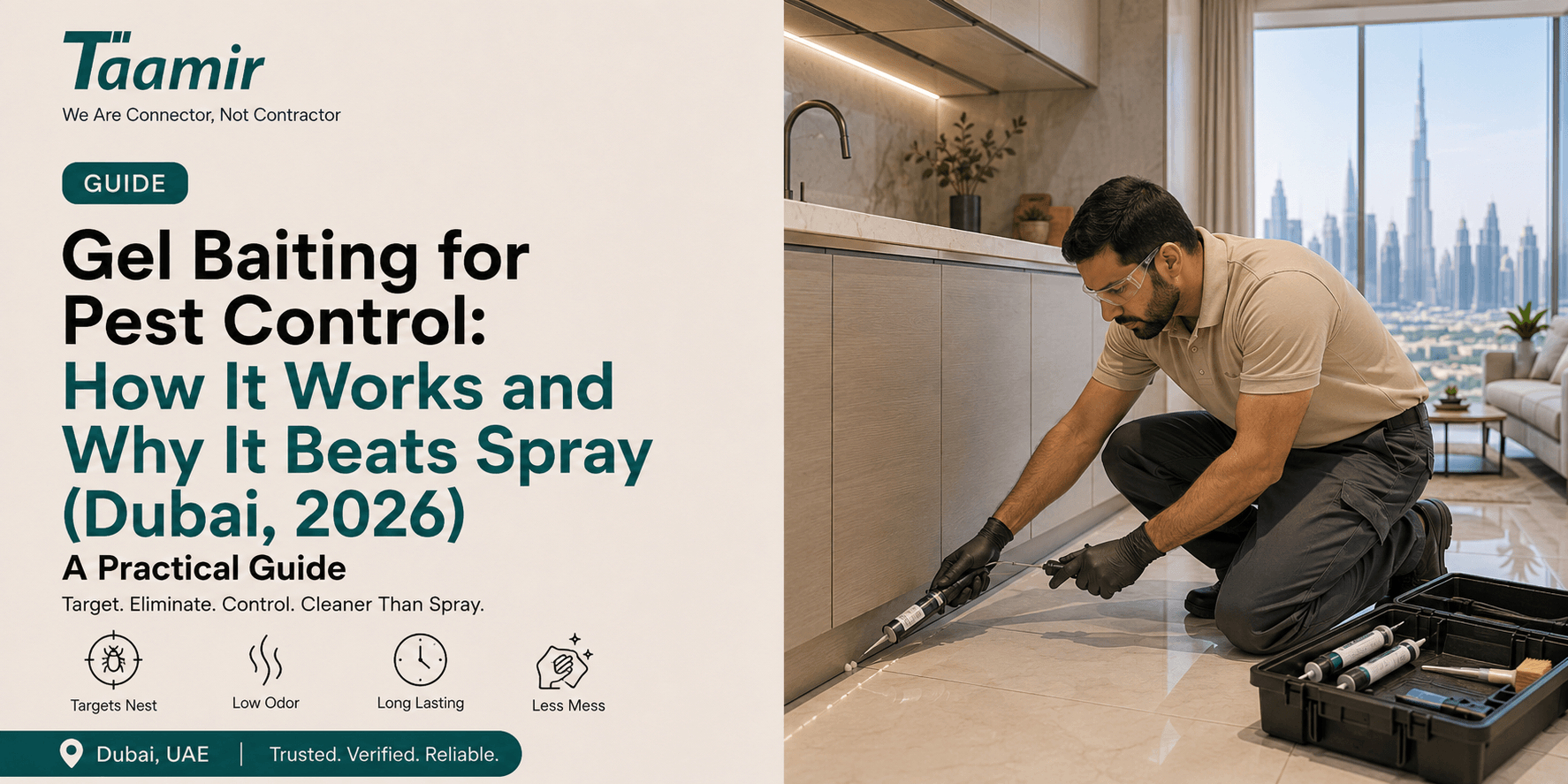
Gel Baiting for Pest Control: How It Works and Why It Beats Spray (Dubai, 2026)
Gel baiting works from the inside out: insects eat a food-like gel laced with a slow-acting insecticide, carry it back to the nest, and pass it through the colony — killing the ones you never see. It's the professional's preferred method for cockroaches and ants, precisely because it attracts pests rather than repelling them the way sprays do. Done well, it clears an infestation at the source; the craft is all in where the gel goes.
If you've ever emptied a can of spray at a cockroach, watched it vanish behind the cabinet, and seen three more the next night, you've met the limitation of spraying. Gel baiting is the method that solves it — and understanding how it works explains why professionals reach for it first, and why the way it's applied matters more than how much is used. Whether you're weighing your options or deciding to bring in a verified pest-control professional on Taamir, here's exactly how gel baiting does its job.
What gel bait actually is
Gel bait is a sticky, food-like paste — sugars and proteins that foraging insects actively want to eat — combined with a slow-acting insecticide. The slow action is the whole point: it gives the insect time to return to its harborage and share the bait before it takes effect, rather than dropping on the spot. It's applied as small, pea-sized dots using a syringe or a professional bait gun, which places precise amounts exactly where they're needed.
How it works: the colony effect
This is what makes gel baiting clever. It doesn't rely on killing the insect in front of you — it relies on that insect doing the work for you. A foraging cockroach or ant finds a bait dot, eats it, and returns to the hidden nest. There, the insecticide spreads through the colony by what's called secondary transfer: other insects are affected through contact, droppings, and the natural cannibalism of the colony. One insect that visits a bait dot can lead to the death of many more that never left the nest.
That's the difference that matters. A pest you can see is a small fraction of the colony hidden in the walls, voids, and cracks. Gel baiting reaches the part you can't see — which is exactly the part that repopulates a home after a surface spray.
Why it beats spraying
Sprays and gels work in opposite ways, and it's worth understanding why:
Sprays repel. Most cockroaches and ants avoid a freshly sprayed surface, so a spray kills the few it hits directly and drives the rest deeper into the structure — often scattering a single colony into several harder-to-reach ones.
Gel attracts. Because the bait is food the insects are actively foraging for, they seek it out rather than avoiding it — and then carry it home. Contact killing versus colony elimination is the whole difference.
This is why gel baiting has become a primary method in professional pest control for these species, rather than a niche one. It targets the colony through the insects' own behaviour instead of trying to out-spray a population that's mostly out of reach.
Where the dots go: placement is everything
Here's the single most important thing about gel baiting: location matters far more than quantity. A few dots in the right places beat a whole tube in the wrong ones. The bait has to sit in or right beside where insects actually harbour and travel, because they need to encounter it while foraging. That means:
Cabinet hinges and corners, and inside cupboards.
In and under appliances — behind and beneath the fridge, microwave, dishwasher, toaster, and cooker hood, where warmth and food residue draw insects in.
Under the sink, around pipe entries and damp spots.
Behind kick-boards and along cracks and crevices.
Many small placements, not a few large ones — the more good locations, the faster the result.
And just as important, where the gel should not go:
Not on open, exposed surfaces — insects won't feed in the open, and it's an unnecessary contamination risk.
Not near heat sources like ovens or hot surfaces, which degrade the bait.
Never next to a sprayed surface — more on that below.
Why gel bait sometimes doesn't work
When baiting fails, it's almost always one of these — and each has a fix:
Competing food. This is the big one. If there are crumbs under the toaster, grease behind the cooker, or pet food left out overnight, the insects have better options and ignore the bait. Sanitation is what makes baiting work — remove the competing food, and the bait becomes the best meal available.
Spraying near the bait. Spray residue repels insects away from the very dots meant to kill them, and can contaminate the bait so they won't touch it. Pick one method per area — if you're baiting, don't spray around it.
Too few placements, or the wrong spots. Bait far from harborages doesn't get found. The fix is more placements, closer to where the activity actually is.
Old, dried-out bait. Gel dries over time and stops being appetising. It needs refreshing to keep working.
Bait aversion. Some insect populations learn to avoid a particular bait. Professionals counter this by rotating the active ingredient periodically rather than relying on one product indefinitely.
The wrong bait for the pest. Ant gels and cockroach gels are formulated differently, and even different ant species have different sugar-versus-protein preferences. Matching the bait to the species matters.
Is gel bait safe around children and pets?
The ingredients can be harmful if ingested, so this matters — and there's a neat overlap between safe and effective here: the best placements for working are also the safest. Deep inside cracks, crevices, cabinet hinges, and behind appliances is exactly where insects forage and exactly where children and pets can't reach. Applied properly and out of the open, gel bait keeps its risk low and its effectiveness high. Following the product's safety instructions, and keeping it out of reach, is non-negotiable.
What to expect, and when
Gel baiting isn't instant, and that's by design — but it's not slow either. With the bait well placed and competing food removed, you'll typically see activity start to drop within a few days, and meaningful colony reduction over roughly two to four weeks as the secondary transfer works through the nest. If numbers haven't fallen after a couple of weeks of proper baiting, that usually means competing food, poor placement, or an infestation large enough to warrant professional treatment.
Gel baiting and the professional approach
There's a reason professionals get more from gel baiting than most homeowners do. They identify the harborages first, place the bait where it will actually be found, use professional-grade formulations that often outperform consumer products, and rotate active ingredients to stay ahead of aversion — all as part of a broader integrated approach that pairs baiting with sanitation and exclusion. It's also a question of using the right products safely: Dubai Municipality's Public Health Pest Control Section approves the pesticides used, certifies technicians, and works to integrated pest management principles, which is exactly the standard a targeted method like gel baiting fits into. Choosing an approved professional means the right bait, in the right place, applied safely.
How Taamir fits in
Because gel baiting lives or dies on correct identification and placement, the professional you choose makes the difference. On Taamir you can compare verified pest-control professionals side by side — every listed provider passes Taamir's verification before you ever see them — review their quality signals, and connect directly. For a cockroach or ant problem specifically, three things worth confirming with any candidate: whether they identify the species and target the harborages rather than simply spraying, whether they are Dubai Municipality-approved and use approved products applied safely around your home, and whether a follow-up visit is included to refresh bait and break the breeding cycle. Because Taamir adds no commission, the quote reflects the work — and once you've found a professional you trust, rebooking them for a follow-up or seasonal check takes minutes.
Frequently Asked Questions
How does gel bait actually kill cockroaches and ants?
Insects eat the food-like gel, which contains a slow-acting insecticide, and return to the nest before it takes effect. There, it spreads through the colony by secondary transfer — contact, droppings, and cannibalism — so one insect that finds the bait leads to the death of many hidden in the nest.
Is gel bait better than spray?
For cockroaches and ants, generally yes. Sprays repel insects and kill mainly what you can see, often scattering the colony deeper. Gel attracts insects and is carried back to the nest, targeting the colony you can't reach. That's why gel baiting is a primary method in professional pest control for these species.
Where should gel bait be placed?
In or right beside where insects harbour and travel — cabinet hinges and corners, in and under appliances, under the sink, behind kick-boards, and along cracks. Use many small pea-sized dots rather than a few large ones, and never on open surfaces or near heat. Placement matters more than quantity.
Why isn't my gel bait working?
The most common reason is competing food — crumbs, grease, or pet food give insects better options, so clean thoroughly. Other causes: spraying near the bait (it repels them), too few or poorly placed dots, dried-out old bait, or the wrong bait for the species. Bait aversion is fixed by rotating the product.
Is gel bait safe around children and pets?
Its ingredients can be harmful if ingested, so placement out of reach is essential — and conveniently, the most effective spots (deep in cracks, hinges, and behind appliances) are also the ones children and pets can't get to. Always follow the product's safety instructions.
How does Taamir help with a cockroach or ant problem?
Taamir lets you compare verified pest-control professionals in one place, check their quality signals before committing, and connect directly with no commission on your quote. For baiting specifically, you can ask upfront about species identification, Dubai Municipality approval and approved products, and whether a follow-up visit is included.
The smarter way to deal with cockroaches and ants
Gel baiting beats the spray-and-hope cycle because it works on the colony, not just the insect in front of you — and done properly, it's both safer and more effective. When the problem is more than a stray or two, find and compare verified pest-control professionals on Taamir, review their quality signals, and connect directly — no commission, no hidden charges.