What to Do If You Notice an Electrical Problem at Home (Dubai, 2026)
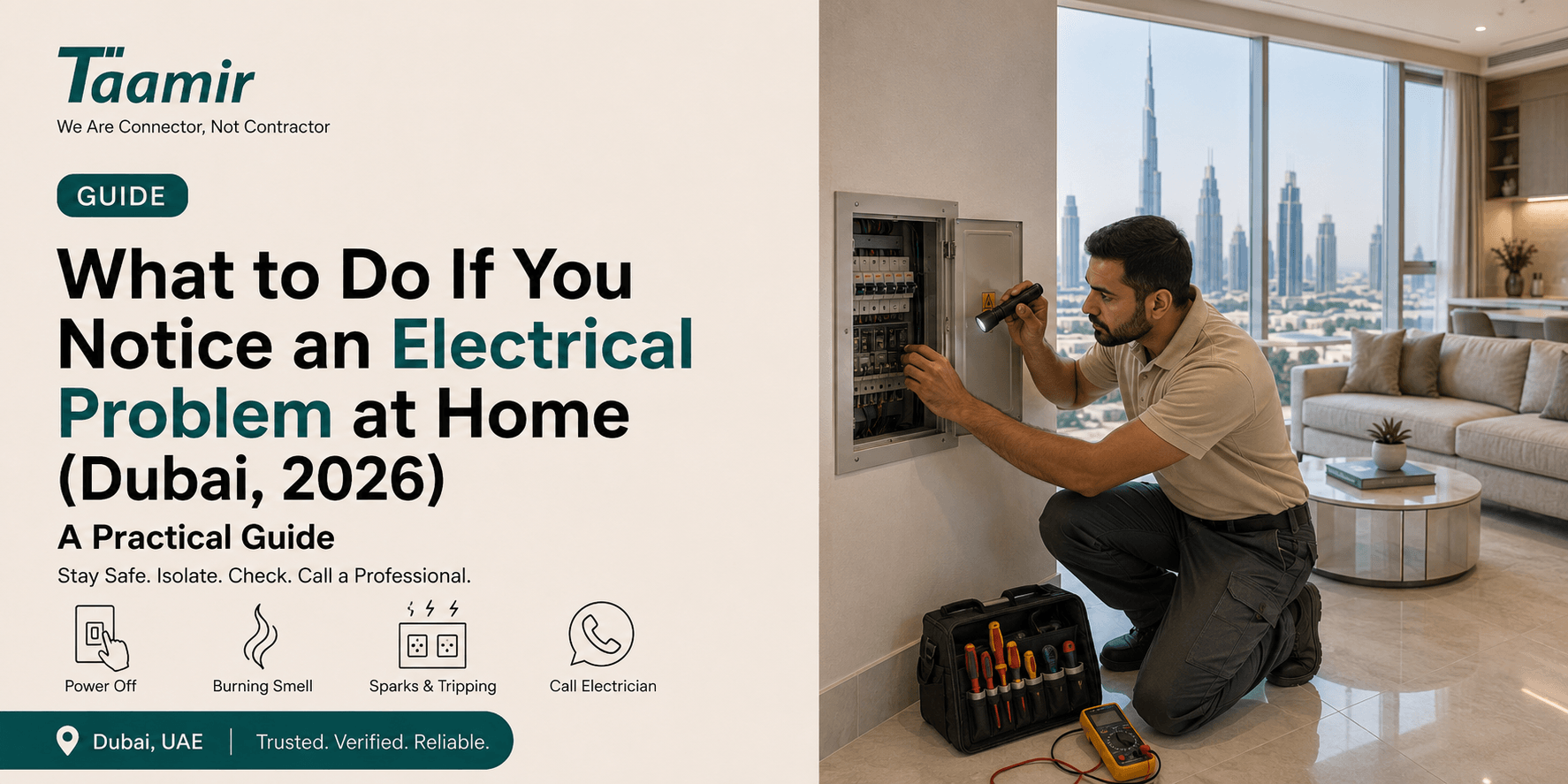
What to Do If You Notice an Electrical Problem at Home (Dubai, 2026)
If something electrical seems off at home, what you do next depends on the sign. A flickering light starts with the bulb and the fitting. A socket or switch that feels warm means stop using it and call a licensed electrician the same day. A breaker that trips repeatedly should be diagnosed rather than reset again. Any buzzing from the distribution board is a professional's job, not a DIY inspection.
Home electrical systems are built to be reliable, and most run quietly in the background for years. But if a sign does appear, it helps to know immediately which ones are a simple check and which ones call for a licensed professional — that single distinction saves both guesswork and unnecessary worry. This guide walks through each sign in turn with a clear response for each, and points you to a verified electrical professional on Taamir at exactly the moments where that's the right call.
Set the rule before anything else
There's a clean line between what's sensible to check yourself and what belongs to a licensed electrician.
Fine to do yourself: change a bulb, reset a tripped breaker once, unplug an appliance you suspect, press the reset button on a bathroom safety socket.
Not DIY, ever: anything involving wiring, opening a socket or switch plate, working inside the distribution board, or repeatedly resetting a breaker that keeps going. DEWA's consumer guidance is clear on this — exposed wires, improper earthing connections, and damaged electrical parts should be fixed with the help of a certified electrician or technician, with electrical cabinets kept closed and unused conduits sealed. That's a good standard to hold to at home.
If a light flickers or dims
Start with the simplest explanation. Check the bulb is screwed in fully, and that it's the right type for the fitting — a dimmable fitting needs a bulb labelled dimmable, and a mismatch can cause flicker on its own. Swap in a known-good bulb of the correct type before assuming anything further.
What to do if it continues: if the flicker persists, several lights flicker at once, or lights dim noticeably whenever one appliance starts, the answer sits past the bulb — a loose connection, a failing switch, or a circuit carrying more than it comfortably should. That's the point to stop testing and book an electrician for a proper diagnosis.
If a socket or switch feels warm
Act on this one straight away. Sockets and switches should sit at room temperature, so warmth, discolouration, a buzzing sensation when touched, or any burning smell means stop using that point immediately and have it checked the same day. Don't plug anything else into it, and don't open the plate to look inside. It's quick for a professional to resolve once they're there — the important part is not leaving it in use in the meantime.
If a socket stops working
Start at the distribution board. A tripped breaker sits in a middle position rather than fully off, and many bathrooms and kitchens have a safety socket with its own reset button that cuts a whole group of outlets when it trips. Reset it and see whether normal service returns.
What to do if it doesn't: if the socket stays dead, or the breaker won't hold, the fault is in the socket or the wiring behind it. That means opening things up, which is professional territory rather than a weekend job.
If a breaker trips
An occasional trip is the system doing its job — protecting the circuit when too much is drawn at once, usually because several heavy appliances landed on the same line together. Spread the load across circuits and it typically settles.
What to do if it repeats: a breaker that trips again and again, with no clear pattern, is pointing at something specific — a circuit carrying too much, a faulty appliance, or a wiring fault. Diagnose it rather than resetting on repeat; our guide to what to do when a fuse box keeps tripping works through the causes in order and how to narrow them down.
If you hear buzzing from the distribution board
The board should be silent. A buzz, hum, or crackle can indicate a loose breaker, an overloaded circuit, or a component beginning to fail — and none of those are a DIY inspection. Keep the panel closed and book a professional to look at it.
If bulbs burn out quickly in one fitting
If a single fitting gets through bulbs while everything else is fine, look at the fitting rather than the bulbs: a poor contact in the holder, a loose connection at the light point, or the wrong bulb type for that fixture. It's a small, quick fix for an electrician — and worth doing, because replacing bulbs repeatedly only treats the symptom.
Keeping the load sensible
Much of what prompts these signs comes down to how load is spread, and that's easy to get right:
Don't daisy-chain extension leads, or run several high-draw appliances from a single point. Spread them across circuits instead.
Follow the appliance guidance. As Gulf News reports, DEWA advises that appliances shouldn't be run beyond their capacity, and that multiple devices shouldn't be connected to a supply point beyond what it's rated for — along with using quality appliances and qualified technicians for installation and maintenance.
Retire tired accessories early. Cracked plugs, frayed leads, and loose-feeling switches are inexpensive to replace and worth replacing before they become a question.
Use quality fittings, correctly installed. A good light fitting properly installed removes a whole category of flicker questions before they start.
Keep the AC well maintained. A system running efficiently is easier on everything around it — the same logic behind our guide to what to do when an AC isn't cooling, and a good reason to keep air-conditioning servicing on the calendar.
Plan power during renovations. Adding sockets where you actually use them — desk height, kitchen counters, bedside — is far easier while walls are open, and it pairs naturally with any smart-home lighting or controls you're considering.
Book a periodic check after renovation work, if a socket or switch has behaved oddly more than once, or simply if the system hasn't been looked at in several years.
Choosing who does the work — and how Taamir fits in
Electrical work is the clearest case for choosing a professional carefully rather than quickly, because the work is largely invisible once the plate goes back on. On Taamir you can compare verified electrical professionals side by side — every listed provider passes Taamir's verification before you ever see them — review their quality signals, and connect directly. For an electrical job specifically, three things worth confirming with any candidate: whether they'll diagnose the cause rather than just replace the visible part (a swapped socket doesn't resolve a loose connection upstream), whether they can carry out a broader safety check of the distribution board and circuits while they're there, and whether they'll test the affected circuit before leaving and explain what caused it. Because Taamir adds no commission, the quote reflects the work — and once you've found an electrician you trust through Taamir, calling the same person for the next job takes minutes.
Frequently Asked Questions
My light flickers in one room — what should I do?
Check the bulb first: make sure it's seated fully and is the correct type for the fitting, then try a known-good replacement. If the flicker continues, or it's triggered by touching the switch, the switch or its connection likely needs replacing — that's a job for a licensed electrician rather than further testing.
What should I do if a plug socket feels warm?
Treat it as urgent. Stop using that socket immediately and have it checked the same day, and don't open the plate yourself. Sockets and switches should stay at room temperature, so warmth, discolouration, buzzing, or a burning smell all warrant a professional the same day.
Can I reset a tripped breaker myself?
Resetting once is fine — that's exactly what breakers are designed for, and an occasional trip usually just means too much landed on one circuit at once. What isn't fine is resetting the same breaker repeatedly: that's the signal to have the circuit diagnosed rather than overridden.
What should I do if lights dim when the AC starts?
A brief dip as a large appliance starts can be normal. If it's noticeable every time, it suggests the circuit is carrying more than it comfortably should, or there's a loose connection in the line — worth having the load distribution checked by an electrician.
When is an electrical safety check worth booking?
Sensible triggers: after renovation work, if a socket or switch has behaved oddly more than once, if breakers trip without a clear cause, or simply if the system hasn't been inspected in several years. A check is quick and replaces guesswork with a clear picture.
How does Taamir help with electrical work?
Taamir lets you compare verified electrical professionals in one place, check their quality signals before committing, and connect directly with no commission added to your quote. For electrical jobs that matters more than most — you can ask upfront about proper diagnosis, a wider safety check, and circuit testing before they leave.
Know the sign, know the next step
Most electrical signs have a simple explanation and a quick professional fix — and the few that matter are worth acting on the same day. Find and compare verified electrical professionals on Taamir, review their quality signals, and connect directly.