Wood Flooring Designs for Dubai Homes — Every Style Explained
In This Guide
1. Why Design Matters as Much as Material
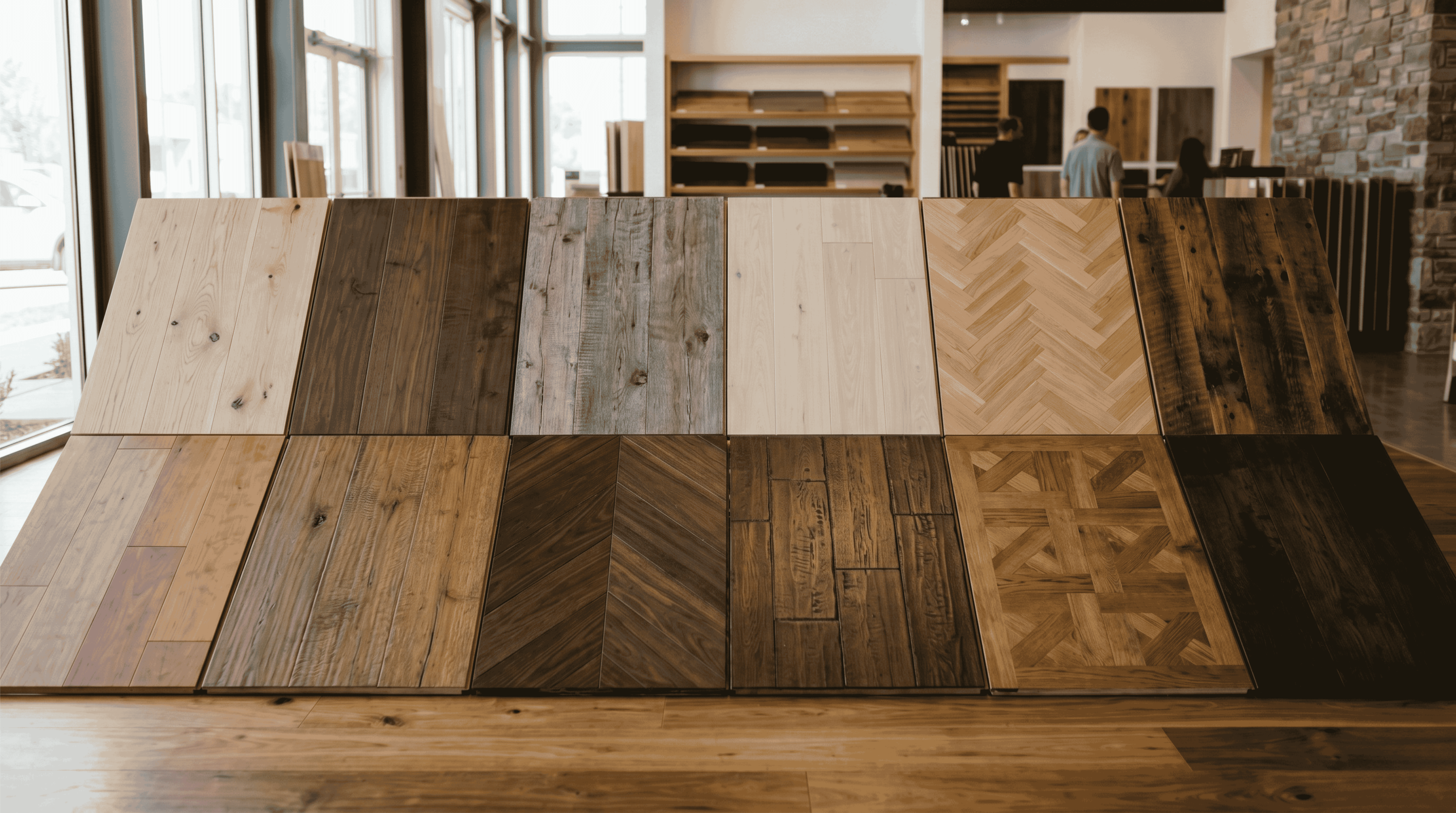
2. Laying Patterns — How the Same Wood Looks Completely Different
3. Herringbone — The Parisian Classic
4. Chevron — Herringbone's Sharper Cousin
5. Straight Plank — The Timeless Standard
6. Wide Plank — Space, Character, and Luxury
7. Versailles and Basketweave — Statement Patterns
8. Wood Species and What They Bring to a Room
9. Finishes — How the Surface Changes Everything
10. Colour Tones — From Blonde to Near-Black
11. Wood Flooring Alternatives That Mimic the Look
12. Which Design Works in Which Room
13. Cost Guide for Wood Flooring Designs in Dubai (2025)
14. Frequently Asked Questions
1. Why Design Matters as Much as Material
Most homeowners spend the majority of their wood flooring budget on the material itself — the species, the grade, the engineered construction — and treat the design choices as secondary. This is a mistake. The laying pattern, plank width, finish, and colour tone of a wood floor have as much impact on the final result as the species itself. A narrow straight-laid pale oak floor and a wide-plank herringbone smoked oak floor are both wood, both European oak, and potentially made from the same raw material — but the two rooms they create are completely different in character, scale, and mood.
In Dubai, where interiors tend toward the considered and the premium, these design decisions carry particular weight. The villa and apartment market here is design-literate. Buyers and renters can distinguish between a thoughtfully specified wood floor and a generic one, and that distinction shows up in both the perceived quality of a home and its market value.
Understanding the full range of design options available to you before you commit to a specification is therefore not a luxury — it is the foundation of a flooring decision you will live with for many years.
Find and compare wood flooring professionals on Taamir — see their previous projects →
2. Laying Patterns — How the Same Wood Looks Completely Different
The laying pattern is the single most powerful design variable in wood flooring. It determines the visual rhythm of the floor, the apparent size and shape of the room, and the overall character of the interior. Two rooms laid with identical boards in different patterns will feel like entirely different spaces.
There are six primary laying patterns in use across Dubai homes today: straight plank, herringbone, chevron, wide plank, Versailles panel, and basketweave. Each has a distinct visual logic, a different installation complexity, and a different level of material waste — which affects cost. The sections that follow explain each one in detail.
A note on direction: even within the straight plank pattern, the direction of the boards relative to the room's longest wall or primary light source dramatically affects how the space reads. Boards laid parallel to the longest wall elongate the room. Boards laid across the shortest dimension push the walls apart visually. Diagonal laying — at 45 degrees to the walls — adds dynamism and makes a room feel larger, but increases waste and installation time. These are decisions worth making intentionally, not by default.
Browse wood flooring professionals and see previous projects on Taamir →
3. Herringbone — The Parisian Classic
Herringbone is the most sought-after wood flooring pattern in the Dubai luxury residential market, and it has earned that status across centuries of use in the finest interiors in Europe and the Middle East. The pattern is formed by laying rectangular planks at 90-degree angles to each other in a continuous zigzag, creating a broken V-shape that repeats across the entire floor. The name comes from the resemblance to the skeleton of a herring fish — each plank representing a rib branching from a central spine.
The visual effect of herringbone is movement and depth. Unlike a straight-laid floor, which reads as a series of parallel lines, herringbone creates a complex interlocking geometry that draws the eye across the surface and gives the floor a texture and richness that no other pattern can replicate at the same scale. In a Dubai villa living room or master bedroom, a wide-plank herringbone floor in a warm oak tone is one of the most effective single design decisions available.
Standard Herringbone vs. Double Herringbone
Standard herringbone uses single planks arranged in the classic 90-degree zigzag. Double herringbone — also called double brick herringbone — pairs two planks side by side before turning, creating a bolder, blockier version of the same pattern. Double herringbone has a more architectural quality and works particularly well in large rooms where the standard pattern might feel too fine in scale relative to the space.
Plank Size in Herringbone
The proportions of the individual plank have a significant effect on how herringbone reads. Narrow planks — 60 to 80mm wide — create a fine, intricate pattern with high visual complexity. This works beautifully in smaller rooms or spaces where intimacy is the goal. Wider planks — 100 to 130mm — produce a bolder, more contemporary herringbone with fewer lines and greater presence. The wider the plank, the more modern the result; the narrower the plank, the more traditional.
What Herringbone Works Best With
Herringbone is at its best in rooms with a clear focal point — a fireplace, a statement sofa arrangement, a feature wall — because the pattern complements rather than competes with strong design elements. It works in both traditional and contemporary interiors depending on the species and finish chosen. A pale, wire-brushed oak herringbone reads as modern Scandinavian. A rich, dark walnut herringbone reads as classic European luxury. The same geometry, completely different mood.
• Best rooms: living rooms, master bedrooms, studies, entrance halls.
• Plank size: 60 to 130mm wide, 300 to 600mm long.
• Material waste: 10 to 15 percent above straight-lay due to cutting at pattern edges.
• Installation time: 30 to 50 percent longer than straight plank due to precision required.
Find herringbone parquet flooring professionals on Taamir →
4. Chevron — Herringbone's Sharper Cousin
Chevron is frequently confused with herringbone, and at a glance the two patterns look similar — both create a zigzag across the floor. But there is a fundamental geometric difference. In herringbone, each plank is rectangular and butts against the end of the adjacent plank at 90 degrees, creating the stepped zigzag. In chevron, each plank is cut at an angle at both ends — typically 45 degrees, though other angles are used — so that when placed together, the planks form a continuous, unbroken V-shape that points in a single direction across the room.
The result is a pattern that feels more directed and dynamic than herringbone. Where herringbone creates interlocking movement, chevron creates momentum — the eye is pulled along the floor in the direction the V-shapes point. This makes chevron particularly effective in corridors, hallways, and long open-plan spaces where that directional energy enhances the architecture.
The Precision Requirement
Chevron is more demanding to install than herringbone because each plank must be cut to a precise angle before laying. Any inaccuracy in the cut — even a fraction of a degree — accumulates across the room and produces a pattern that does not close cleanly at the apex of the V. This makes the quality of the installer even more important than with herringbone. The finished result of a well-laid chevron floor is exceptional. The finished result of a poorly laid one is conspicuously wrong.
Angle Variations
The standard chevron angle is 45 degrees, which produces a balanced V-shape. Steeper angles — 60 degrees — create a more elongated, sharper chevron that feels contemporary and fast-moving. Shallower angles — 30 degrees — produce a flatter, wider chevron with a more relaxed quality. Each angle creates a distinctly different room character from the same material.
• Best rooms: hallways, corridors, open-plan living and dining areas, master bedrooms.
• Plank size: similar to herringbone — 70 to 120mm wide works well.
• Material waste: 15 to 20 percent above straight-lay due to angled end cuts.
• Installation time: higher than herringbone due to precision angle cutting.
Find chevron and parquet wood flooring professionals on Taamir →
5. Straight Plank — The Timeless Standard
Straight plank — boards laid in parallel rows running the length of the room — is the default wood flooring layout and the most widely installed pattern in Dubai homes. Its simplicity is not a limitation. It is a design choice that, when executed with the right species, width, and finish, produces interiors of genuine distinction. The straight plank pattern is a neutral that lets other elements of the room — the furniture, the lighting, the architecture — take the foreground, which is often exactly what a space needs.
The key design decisions within straight plank laying are direction, width, and the offset between rows. Direction has already been addressed — parallel to the longest wall elongates; perpendicular widens; diagonal dynamises. Width is the other major variable. Narrow boards — under 90mm — create a traditional, fine-grained floor with high plank count and a classic quality. Wide boards — 150mm and above — feel contemporary, relaxed, and spacious.
Stagger Pattern
The stagger — the offset between the end joints of adjacent rows — is a detail that most homeowners never consciously notice but always subconsciously register. A random stagger, where boards of varying lengths are mixed to create irregular joint positions, looks the most natural and is the standard for most installations. A fixed stagger — where every joint is offset by exactly one-third or one-half of the board length — creates a more deliberate, geometric quality that suits contemporary interiors. A brick-bond stagger — where every alternate row starts at the exact midpoint of the board above — is bold and graphic.
End-Matched vs. Not End-Matched
End-matched boards have a tongue and groove cut into both the long and short edges, allowing planks to be joined end-to-end within a row. This is the professional standard for all quality straight-plank installations and eliminates gaps between board ends that can develop as the floor acclimatises to Dubai's humidity cycles.
• Best rooms: every room — straight plank is universally appropriate.
• Plank width: 80 to 240mm depending on room size and design intent.
• Material waste: 5 to 8 percent, the lowest of all patterns.
• Installation time: the fastest of all wood flooring patterns.
Find straight plank wood flooring professionals on Taamir →
6. Wide Plank — Space, Character, and Luxury
Wide plank flooring is not a separate pattern — it is straight plank laying with boards that are significantly broader than standard, typically 150mm to 300mm wide and often 2 to 4 metres long. But the visual and tactile effect of very wide boards is so different from standard straight plank that it deserves its own discussion.
Wide plank flooring came from the grand country houses of Europe, where timber was plentiful and rooms were large enough to accommodate boards of extravagant width. Today it is one of the most coveted specifications in the Dubai luxury villa market. A floor of 200mm-wide oiled European oak planks, each four metres long with virtually no joints across the span of a living room, has a quality that no narrow-board floor can approach. The wood's natural grain, colour variation, and character are displayed at a scale that makes the material itself the design statement.
Live Edge and Character Grade
Wide plank flooring is most compelling in character grade — boards selected for their natural variation, including knots, mineral streaks, colour movement, and grain irregularities. This is the opposite of the uniform, knot-free appearance of select grade timber that dominated the Dubai market a decade ago. Character grade wide plank feels organic, honest, and genuinely luxurious in a way that perfect, uniform boards do not. It reads as premium because it is rare — the natural markings that were once rejected as defects are now understood as evidence of quality and authenticity.
Dimensional Stability Considerations in Dubai
Very wide boards are more susceptible to movement than narrow boards in response to humidity changes — the wider the board, the greater the potential expansion and contraction across its width. In Dubai, where air conditioning creates consistently dry indoor air, this means wide engineered boards need to be acclimated carefully before installation, and the subfloor must be level and stable. Engineered wide plank — with a real wood veneer over a cross-grain plywood core — is dramatically more stable than solid wide plank and is the appropriate specification for Dubai homes.
• Best rooms: large living rooms, open-plan areas, master bedrooms, villa entrance halls.
• Plank width: 150 to 300mm — the wider the board, the more dramatic the result.
• Board length: 1.8 to 4 metres — longer boards have fewer end joints and look more expansive.
• Material grade: character grade shows the wood's natural beauty at its best.
Find wide plank wood flooring professionals on Taamir →
7. Versailles and Basketweave — Statement Patterns
Beyond herringbone, chevron, and straight plank, there are two additional patterns that appear in high-specification Dubai villa installations: the Versailles panel and the basketweave. Both are statement choices — complex, labour-intensive, and unmistakeable. They are not for every room or every budget, but in the right context they are among the most impressive floor designs available.
The Versailles Panel
The Versailles pattern takes its name from the Palace of Versailles in France, where it was used in the grand apartments of Louis XIV. It is a large square panel design — typically 80 to 100 cm per square — in which narrow strips of wood are arranged in a series of interlocking squares and diagonal elements within each panel. The panels are then repeated across the floor in a grid, creating a continuously complex geometric surface.
In Dubai, the Versailles pattern is used in formal reception rooms, entrance halls, and dining rooms of high-end villas where the floor is intended to be as much a decorative element as the art on the walls. It is almost always executed in a single species — most commonly oak — in contrasting finishes or tones within the same panel to emphasise the geometry. The installation is extremely labour-intensive and requires a highly skilled craftsman. The result, when done well, is without equal in residential wood flooring.
Basketweave
The basketweave pattern uses short rectangular blocks of wood arranged in alternating horizontal and vertical groups, creating the interlocking visual of a woven basket across the floor surface. It has a more relaxed, informal quality than Versailles — warmer and less architectural — and works well in rooms with a Mediterranean, rustic, or traditional character.
In Dubai, basketweave appears most often in secondary reception rooms, libraries, and studies of villas where the owner wants a distinctive floor that is rich in character without the formality of Versailles. It is less widely available from local contractors than herringbone or straight plank and requires a craftsman with specific experience in the pattern.
• Best rooms: formal reception rooms, entrance halls, dining rooms, studies.
• Both patterns suit traditional and transitional interiors more than strictly contemporary ones.
• Installation complexity: the highest of all wood floor patterns — always specify an experienced craftsman.
• Material waste: 20 to 25 percent above straight-lay.
Find and compare specialist parquet flooring craftsmen on Taamir →
8. Wood Species and What They Bring to a Room
The species of wood determines the base colour, the grain character, the hardness, and the way the floor responds to finishing. In the Dubai market, engineered European Oak dominates by a wide margin — it is versatile, stable, widely available, and compatible with every finish and pattern. But it is far from the only option, and understanding the full range of species available opens up design possibilities that oak alone cannot provide.
European Oak
European Oak is the benchmark against which all other species are measured. Its grain is open and pronounced, with a natural honey-to-medium-brown tone that accepts stain, oil, and lacquer beautifully. It is hard enough to handle everyday residential use without difficulty and stable enough — in its engineered form — to perform well in Dubai's climate. Its versatility is its greatest strength: pale bleached oak reads as Scandinavian and contemporary; warm natural oak reads as classic European; smoked or fumed oak reads as dramatic and modern. One species, countless characters.
Walnut
Walnut is the premium dark wood of residential interiors. Its natural colour — a rich chocolate brown with purple undertones — is unique among commercially available flooring species, and it needs no staining to achieve a dramatic result. Walnut grain is typically straighter and more uniform than oak, giving it a quieter, more refined surface quality. In a Dubai master bedroom or study, wide-plank walnut in an oiled finish is one of the most sophisticated flooring choices available. It is also the most expensive domestic hardwood option, with premium grades commanding significant premiums over comparable oak.
Ash
Ash is a light, almost blonde hardwood with a pronounced, graphic grain that is more dramatic than oak at a similar tone. It is very hard — harder than European oak — which makes it an excellent choice for high-traffic areas where durability is a priority alongside aesthetics. In a Dubai interior that leans toward light, airy, Scandinavian or Japanese-inspired design, ash wide plank in a natural or lightly oiled finish creates a floor of exceptional freshness.
Smoked and Fumed Oak
Smoked oak is not a different species — it is European oak that has been treated with ammonia vapour or heat during production, which reacts with the tannins naturally present in oak to produce a deep grey-brown colour that penetrates the full thickness of the board. Unlike a surface stain, smoked colour cannot scratch off or wear away — it is intrinsic to the wood itself. Smoked oak wide plank is the defining flooring of contemporary luxury interiors in Dubai and globally, and its popularity in the market has grown dramatically over the past five years.
Herringbone-Specific Species
For herringbone and chevron patterns, the species choice has additional implications. Pale species — ash, light oak — emphasise the geometric complexity of the pattern because the colour contrast between adjacent boards is lower and the pattern itself carries the visual interest. Darker species — walnut, smoked oak — create a more dramatic effect where both the colour depth and the pattern contribute equally to the overall impression.
Bamboo
Strand-woven bamboo is not technically a wood — it is a grass — but it performs like a hardwood flooring material and is available in engineered form compatible with Dubai's climate requirements. It is harder than most hardwoods, grows rapidly making it highly sustainable, and is available in natural, carbonised (warm caramel), and smoked tones. For homeowners who want a wood-look floor with strong environmental credentials, strand-woven bamboo is a genuine option alongside traditional hardwood species.
Find and compare wood flooring professionals across species on Taamir →
9. Finishes — How the Surface Changes Everything
The finish applied to a wood floor changes its colour, its sheen level, its texture, and its maintenance requirements — sometimes more dramatically than the species itself. Two identical oak herringbone floors, one lacquered and one oiled, will look and feel completely different even before you account for any colour treatment. Understanding finishes is therefore central to the design decision, not a detail to be resolved by the installer on site.
Oiled Finish
An oil finish penetrates into the wood fibres rather than sitting on top of the surface as a film. The result is the most natural-looking finish available — the wood's grain, colour, and texture are fully visible, the surface has a very low, matte sheen, and the floor feels warm and alive underfoot rather than coated. Oiled floors are the preferred choice in design-led Dubai interiors for exactly these qualities.
The trade-off is maintenance. Oiled floors require periodic re-oiling — typically once a year in heavily used areas — to maintain their protection and appearance. Localised damage — a scratch or a stain — can be spot-repaired on an oiled floor without having to sand and re-finish the entire surface. This is a significant practical advantage over lacquered floors in a household with children or pets.
Hardwax Oil Finish
Hardwax oil is a development of the traditional oil finish that adds wax particles to the oil for greater surface protection without adding visible sheen. It is the most commonly specified finish for quality wood flooring in the Dubai residential market because it combines the natural appearance of an oiled floor with durability closer to a lacquer. Osmo Polyx Oil is the most widely recognised hardwax oil product and sets the standard in the market.
Lacquered Finish
A lacquer finish sits on top of the wood surface as a transparent film, typically applied in multiple coats to build a hard, protective layer. The surface sheen ranges from matte to satin to gloss depending on the product specified. Lacquered floors are easier to maintain on a daily basis than oiled floors — they can be cleaned with a damp mop without any risk of moisture penetration — and their factory-applied finish is extremely durable when new.
The limitation is that a lacquered floor cannot be spot-repaired. When the lacquer scratches or wears through — which eventually happens regardless of quality — the entire floor must be sanded back and re-lacquered. In a Dubai villa with heavy use, this may be needed within five to ten years. The decision between oil and lacquer is therefore partly a decision about maintenance philosophy: oil requires regular small interventions; lacquer requires occasional large ones.
UV-Oiled Finish
UV-oiled floors are factory-oiled and then cured under ultraviolet light to harden the oil surface instantly. The result is a finish with the natural appearance of a traditionally oiled floor but with greater initial durability and a surface that is ready to walk on immediately after installation. In the Dubai market, UV-oiled is the standard factory finish for most quality engineered wood flooring products.
Brushed Finish
A brushed finish is not a coating — it is a surface texture created by running wire brushes across the wood surface before or after oiling, which removes the softer grain between the harder annular rings and creates a lightly textured, three-dimensional surface. Brushed floors are extremely effective at concealing fine scratches and everyday wear because the texture breaks up any visible marks. They also age beautifully, developing character over time rather than showing wear. Brushed and oiled is one of the most popular finish combinations in the Dubai luxury flooring market.
Hand-Scraped Finish
A hand-scraped finish replicates the texture of floors that were manually finished before machine-sanding existed — each board bearing the marks of the craftsman's tool in subtle ridges and valleys across its surface. The effect is artisanal, characterful, and warm. It suits interiors with a rustic, Mediterranean, traditional Arabic, or American farmhouse character. In Dubai it appears most often in villa interiors designed around natural materials — reclaimed stone, exposed timber beams, handmade tiles — where the hand-scraped floor completes the authentic material palette.
• Oiled and hardwax oiled — most natural look, spot-repairable, requires periodic maintenance.
• Lacquered — easy daily maintenance, higher durability when new, full re-sand needed when worn.
• UV-oiled — natural look with factory-hardened durability, the Dubai market standard.
• Brushed — hides wear beautifully, ages with character, always combined with oil or hardwax oil.
• Hand-scraped — artisanal texture, suits traditional and rustic interiors, unique to each board.
Find and compare wood flooring specialists by finish type on Taamir →
10. Colour Tones — From Blonde to Near-Black
The colour tone of a wood floor sets the baseline of an interior's palette. Every other material choice in the room — walls, upholstery, cabinetry, textiles — will be read against it. Getting the tone right is therefore not simply a flooring decision; it is an interior design decision that affects the entire room.
Blonde and White-Oiled
At the palest end of the spectrum, white-oiled and blonde oak floors create interiors of exceptional lightness and airiness. The white oil partially fills the grain of the oak, reducing its natural warm yellow tone to a cool, almost grey-white. The effect is Scandinavian, contemporary, and particularly effective in Dubai apartments where natural light is limited or where the design intent is to maximise the sense of space. White-oiled oak herringbone is one of the most photographed and imitated floor designs in the Dubai interior design market.
Natural and Honey
Natural oil and untreated oak produces a warm honey to medium brown tone — the colour most people think of when they imagine a wood floor. It is the most versatile tone, compatible with warm and cool palettes equally, and the safest choice when the rest of the interior design is still being defined. Natural oak straight plank or herringbone in a hardwax oil finish is the most widely installed quality wood floor in Dubai villas for exactly this reason.
Grey and Greige
Grey-toned floors — achieved through grey-tinted oils, light fuming, or careful species selection — have dominated the Dubai interior design market for the past decade and show no sign of retreating. Grey oak sits at the intersection of the warmth of wood and the cool neutrality of stone. It works with marble, with concrete, with white walls, and with almost every furniture palette. Greige — a grey-beige hybrid tone — is the warmer, softer version, which has grown in popularity as the market has moved away from the cooler, industrial grey of the previous decade toward something slightly more inviting.
Smoked and Dark Brown
Smoked oak and naturally dark species like walnut occupy the warm-dark end of the spectrum. These tones create interiors of drama, intimacy, and unmistakeable luxury. A large Dubai villa living room with wide-plank smoked oak in an oiled finish has an authority that paler floors cannot match. The trade-off is that dark floors show dust, fine scratches, and footprints more readily than mid or light tones — a practical consideration in a region where fine sand is an ever-present domestic challenge.
Near-Black
At the extreme dark end, floors finished in near-black ebonised or heavily charred treatments create interiors of pure drama. These are rare in Dubai residential use — more common in hospitality and retail interiors — but they appear in the most design-confident private homes where the owner has a clear vision and the courage to commit to it. Near-black floors require white or very light walls and ceilings to balance the weight of the floor, and the spaces they create are striking rather than comfortable. They are absolutely not for everyone, but when they work, they are unforgettable.
Find wood flooring professionals who can advise on colour tone on Taamir →
11. Wood Flooring Alternatives That Mimic the Look
Not every room in a Dubai home is suitable for real wood flooring. Bathrooms, kitchens, and laundry rooms demand waterproof materials, and real wood — even engineered — is not appropriate in these spaces. But the desire for a wood aesthetic is entirely understandable, and there are several materials that replicate the look of wood convincingly while delivering performance that real wood cannot match in wet or high-moisture environments.
SPC Vinyl in Wood Designs
Stone Polymer Composite vinyl flooring is available in an extensive range of wood-look designs — wide plank oak, smoked herringbone, pale Scandinavian ash, dark walnut — that are convincing enough at normal viewing distances to be effectively indistinguishable from real wood to most observers. The photographic print layer uses high-resolution scans of real wood grain, and the embossed surface texture replicates the feel of brushed or hand-scraped wood underfoot. SPC is fully waterproof, highly durable, and appropriate for every room including bathrooms and kitchens. For a Dubai apartment where the owner wants a wood aesthetic throughout every room without the compromises of real wood near water, SPC in a quality wood design is the most logical solution.
Find and compare SPC vinyl flooring professionals on Taamir →
Laminate in Wood Designs
Laminate is the entry-level wood-look alternative and the most widely known. Its surface is a photographic print under a hard wear coating on an HDF core. The designs available in the Dubai market range from convincing to generic — quality laminate from European manufacturers in wide-plank designs with embossed surfaces can look very acceptable in dry interior rooms. The critical limitation remains moisture sensitivity. Laminate's HDF core absorbs water and swells irreversibly, making it inappropriate for kitchens, bathrooms, and any moisture-adjacent space in Dubai. For dry interior rooms — bedrooms, home offices, formal living areas — laminate is a viable budget option for a wood aesthetic.
See the laminate flooring guide on Taamir →
Wood-Look Porcelain Tiles
Wood-effect porcelain tiles have improved dramatically in print quality and surface texture over the past decade. Contemporary wood-look porcelain — especially from Italian and Spanish manufacturers — reproduces oak, walnut, and ash grain patterns with remarkable accuracy in large format planks of 20 by 120 cm and above. The result is a floor that reads as wood from a standing position but delivers all the practical advantages of porcelain: full waterproofing, chemical resistance, and zero maintenance. Wood-look porcelain is increasingly popular in Dubai kitchens and bathrooms where a continuous wood aesthetic is desired across wet and dry spaces. It is also the correct choice for outdoor terraces where real wood or SPC would be damaged by the Gulf sun.
Find and compare tile flooring professionals on Taamir →
12. Which Design Works in Which Room
Entrance Hall and Corridor
The entrance hall sets the tone for the entire home. Herringbone or chevron in a rich, dark tone — smoked oak, walnut, or deeply coloured engineered wood — makes an immediate and powerful impression. Wide plank straight lay in a pale tone maximises the sense of space in narrower corridors. The entrance hall is also the highest-traffic area, so a brushed finish that conceals scratches is strongly recommended over a polished surface.
Living Room
The living room is where the most design investment in wood flooring is justified. Wide-plank herringbone or chevron in European oak — natural, smoked, or grey-toned — is the defining floor of the contemporary Dubai luxury villa living room. For very large living spaces, the Versailles panel pattern creates a room of extraordinary grandeur. Straight plank in wide format is the versatile choice that works at every budget level without compromising the overall design.
Dining Room
The dining room benefits from a floor that can handle chair movement, dropped food, and spills without showing immediate damage. A brushed and oiled finish in a mid-tone oak is the practical choice. Herringbone adds formality appropriate to a dining context. Avoid very pale or very dark tones in dining rooms — pale shows food stains; very dark shows dust and fine scratches from chair legs.
Master Bedroom
The master bedroom is the room where the most intimate and personal flooring choice is appropriate. Wide plank walnut in a deep, warm oiled finish creates a room of genuine luxury. Pale ash or white-oiled oak gives a lighter, more restful character. Herringbone works beautifully in bedrooms of significant size — in smaller bedrooms, the pattern can feel busy. A carpet layer over a hard wood floor — with a quality area rug positioned under the bed — combines the warmth of textile underfoot where it matters most with the beauty of wood in the visible floor area.
Children's Room
Children's rooms demand durability above all. A brushed and oiled oak in straight plank — mid-tone, character grade — handles the marks and movement of everyday childhood use better than any other wood specification. Alternatively, SPC vinyl in a quality wood design delivers the wood aesthetic with full waterproofing and the ability to replace individual planks if significant damage occurs. Herringbone and Versailles patterns are not appropriate for children's rooms — the installation cost is wasted on a floor that will inevitably suffer damage.
Study and Home Office
A study benefits from a floor that feels calm, focused, and quality-conscious without demanding attention. Straight plank in a medium-width, natural or grey-toned oak with a matte oiled finish is the professional recommendation. Herringbone adds interest without distraction if the room is of a size that can carry the pattern. Walnut creates an atmosphere of gravitas and concentration that is particularly effective in a working environment.
Find and compare wood flooring professionals for every room on Taamir →
13. Cost Guide for Wood Flooring Designs in Dubai (2025)
Wood flooring costs in Dubai vary across three dimensions: the material itself, the pattern complexity which determines installation labour, and the room preparation required. The figures below cover supply and installation combined for typical residential projects.
By Pattern — Labour Premium Over Straight Plank
• Straight plank, standard width: the baseline. AED 200 to 320 per sqm for mid-range engineered oak.
• Straight plank, wide plank (150mm and above): AED 280 to 500 per sqm depending on species and width.
• Herringbone: add 25 to 40 percent to straight plank cost for the same material due to cutting, waste, and installation time.
• Chevron: add 30 to 50 percent to straight plank cost due to precision angle cutting and higher waste.
• Versailles panel: add 80 to 120 percent to straight plank cost — specialist craftsman and high material waste.
• Basketweave: add 60 to 100 percent to straight plank cost.
By Species — Relative Cost
• Engineered European Oak (standard): the baseline reference price.
• Engineered Ash: similar to oak, slight premium for wider availability of pale tones.
• Smoked or fumed Oak: 20 to 40 percent premium over standard oak.
• Engineered Walnut: 40 to 80 percent premium over standard oak.
• Strand-woven Bamboo: comparable to mid-range engineered oak.
By Finish — Additional Cost
• Standard UV-oiled factory finish: included in board price.
• Site-applied hardwax oil (Osmo or equivalent): AED 15 to 30 per sqm additional.
• Site-applied lacquer: AED 20 to 40 per sqm additional.
• Hand-scraping (site-applied): AED 30 to 60 per sqm additional.
Typical Project Costs
• Master bedroom, straight plank engineered oak, 25 sqm: AED 6,000 to 12,000.
• Living room, herringbone engineered oak, 50 sqm: AED 18,000 to 35,000.
• Living room, wide plank smoked oak herringbone, 50 sqm: AED 28,000 to 55,000.
• Entrance hall, chevron engineered walnut, 15 sqm: AED 9,000 to 20,000.
• Full villa, straight plank engineered oak throughout, 300 sqm: AED 70,000 to 140,000.
These are indicative ranges. Actual costs depend on the specific product, subfloor condition, site access, and the professional engaged. Viewing previous projects completed by a flooring professional is the most reliable way to assess the quality their work delivers at their quoted price.
Find and compare wood flooring professionals — see their previous projects on Taamir →
14. Frequently Asked Questions
What is the most popular wood flooring design in Dubai villas?
Wide-plank herringbone in engineered European oak — most often in smoked, natural, or grey tones with an oiled or hardwax oil finish — is the dominant choice in Dubai villa living rooms and master bedrooms at the premium end of the market. Natural-tone straight plank wide format is the most widely installed design across all budget levels.
Is herringbone more expensive than straight plank?
Yes, significantly. Herringbone requires more boards due to cutting waste at the pattern edges, takes 30 to 50 percent longer to install, and demands a more skilled craftsman to achieve a clean result. Expect to add 25 to 40 percent to the straight plank cost for the same material laid in herringbone.
What is the difference between herringbone and chevron?
In herringbone, rectangular boards butt against each other at 90 degrees creating a stepped zigzag. In chevron, boards are cut at an angle at both ends so they meet to form a continuous, unbroken V-shape. Herringbone feels more complex and traditional; chevron feels more directed and contemporary. Both are appropriate in Dubai villa interiors — the choice depends on the overall design intent.
What wood floor finish is best for Dubai homes?
Hardwax oil — particularly Osmo Polyx Oil or equivalent — is the most widely recommended finish for Dubai homes. It gives the natural appearance of an oiled floor with greater durability, allows spot repairs, and is compatible with the cleaning products and routines of Dubai households. UV-oiled factory finish is the practical standard for most quality engineered boards. Lacquer is appropriate where easy daily maintenance is the priority and full re-sanding every five to ten years is acceptable.
What is smoked oak and how is it different from stained oak?
Smoked oak is produced by exposing the wood to ammonia vapour or heat, which reacts with the natural tannins in the oak to produce a deep grey-brown colour that penetrates the full thickness of the board. Unlike a surface stain, the smoked colour cannot scratch off or wear away — it is intrinsic to the wood. Stained oak has colour applied to the surface only and will eventually show raw wood if the surface is scratched through.
Can I use real wood flooring in my Dubai kitchen?
Engineered wood can work in a Dubai kitchen if the floor is well away from the sink and dishwasher, spills are always wiped immediately, and the owner accepts the maintenance requirements. It is always a compromise compared to porcelain or SPC vinyl in this environment. For the wood aesthetic in a kitchen with full waterproofing, SPC vinyl in a wood design or wood-effect porcelain tile is the more dependable specification.
How do I choose between oil and lacquer for my wood floor?
Choose oil if you want the most natural look and feel, are comfortable with periodic re-oiling, and want a floor that can be spot-repaired without full sanding. Choose lacquer if you want the easiest daily maintenance and are comfortable with a full re-sand and re-coat every five to ten years when the surface eventually wears. In Dubai's family villa market, hardwax oil is the most widely recommended compromise between these two positions.
Can I see examples of wood flooring projects before choosing a professional?
Yes. On Taamir you can browse flooring professionals in Dubai and view their previous projects before making a decision. Seeing completed work in real homes is the most reliable way to assess both technical quality and design sensibility.
Find and compare wood flooring professionals — see previous projects on Taamir →
Find the Right Professional for Your Wood Floor
On Taamir you can browse wood flooring professionals across Dubai, Abu Dhabi, and Sharjah who specialise in every pattern, species, and finish covered in this guide. See their previous projects and compare their profiles to find the right craftsman for your home.