Wallpaper Trends 2026: What’s In, and What Works in Dubai
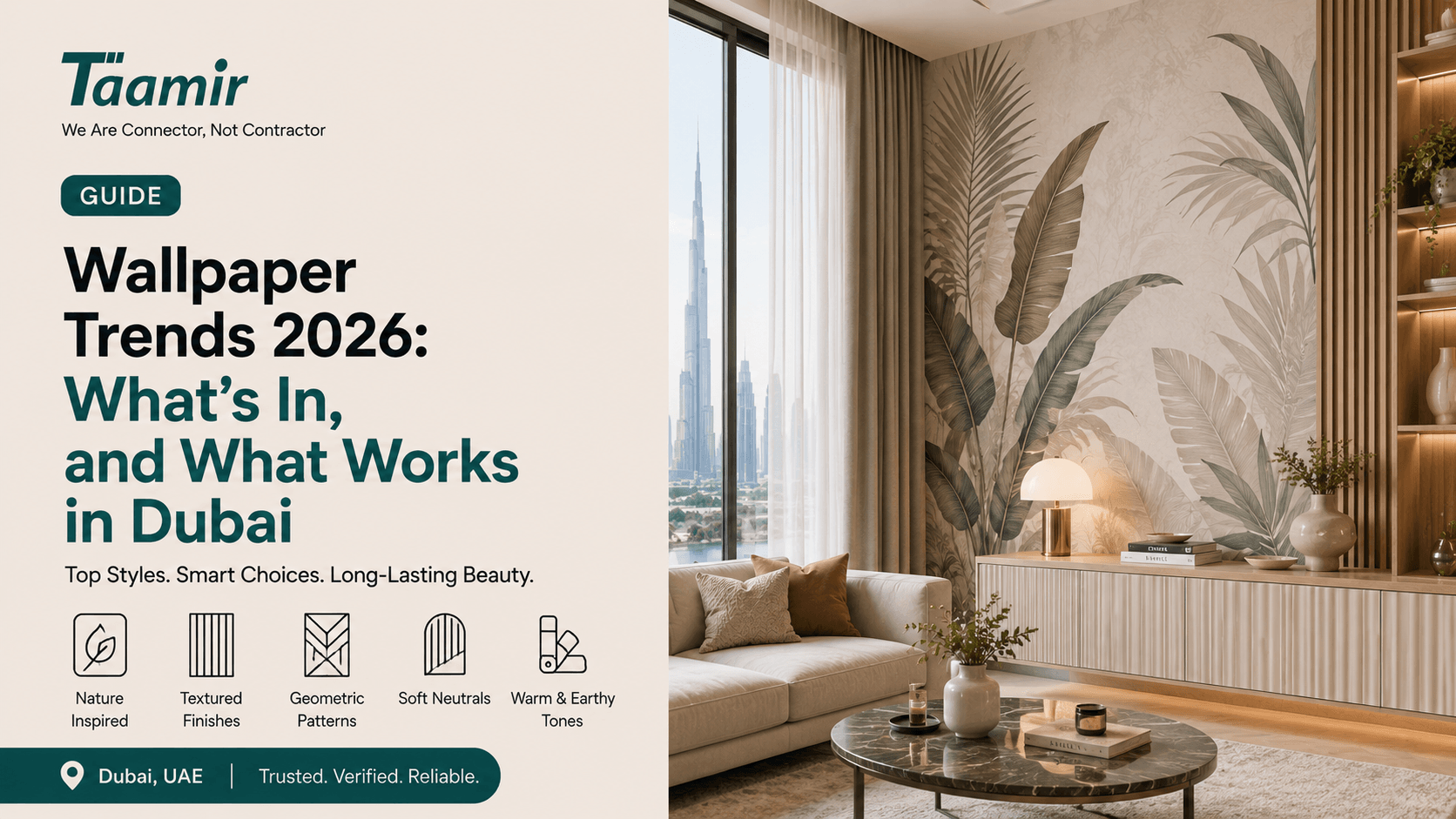
Wallpaper Trends 2026: What’s In, and What Works in Dubai Homes
The wallpaper trends defining 2026 are texture over flat print (grasscloth, linen, plaster and woven looks), large-scale murals in place of small repeats, an Art Deco revival, wallpapered ceilings, and deeper, warmer palettes. For a Dubai home the material matters as much as the pattern: vinyl and non-woven papers handle kitchens and powder rooms comfortably, while natural fibres are best kept to dry, air-conditioned rooms.
Wallpaper has shifted from something people removed to something people plan a room around. Printing has improved, adhesives and backings have improved, and removable formats mean a bold choice is no longer a ten-year commitment. The result is that walls are being treated as a surface with texture and depth rather than a flat backdrop — and because the difference between a striking papered wall and an obviously amateur one is almost entirely in the preparation and the seams, it is worth comparing verified wallpaper professionals on Taamir before you start.
Why wallpaper is having a moment
Three things are driving it. Designers and homeowners alike have tired of flat, uniform walls, and texture is the fastest way to add warmth without adding clutter. Digital printing now reproduces fabric weaves, plaster and hand-painted artwork convincingly at scale, so a mural is a file rather than a commission. And the format choice has widened — traditional non-woven papers for permanent installations, peel-and-stick for anything you might change. Design publications tracking the 2026 collections describe the same direction: panoramic murals and tactile, textural surfaces taking over from small repeating patterns, with stripes returning as a way to play with a room’s proportions.
The eight looks defining 2026
1. Texture-first walls
The headline trend. Grasscloth, linen and silk looks, plaster effects, woven patterns and embossed designs that create real depth and shadow rather than printed imitation. Texture reads as considered even in a neutral palette, and it hides minor wall imperfections in the process. Best in bedrooms, living rooms, studies and dining rooms.
2. Large-scale and panoramic murals
Oversized scenic and painterly murals have replaced the modest accent wall. The shift within the trend is worth noting: photographic forest-and-cityscape prints are giving way to painterly, hand-drawn and watercolour interpretations that read as artwork rather than a screensaver. One wall carries the room, so everything else can stay restrained.
3. Art Deco revival
Clean lines, geometric repeats, fans and arches, and a sense of glamour — often with metallic or gilded accents. It suits entrance halls, powder rooms and dining rooms, spaces where you want immediate impact, and because the geometry is classical it tends not to date the way a novelty print does.
4. The fifth wall: wallpapered ceilings
One of the most-mentioned 2026 ideas. A papered ceiling in a bedroom, powder room or dining nook adds enclosure and surprise, and it works particularly well in a room where you want pattern without covering the walls. It is also the least forgiving installation in the house, which makes it a professional job.
5. Deeper, warmer palettes
Terracotta, clay, olive and sage, honey and tobacco, warm beige and sand — plus richer jewel tones on dark grounds. Cool grey has receded; warmth is the organising idea, and it flatters the strong natural light most Dubai apartments get.
6. Softened geometrics
Geometry is still here, but the execution has changed: arches, organic curves and hand-drawn lines rather than sharp rigid repeats. Large-scale geometric murals that suggest architecture — arched forms, faux panelling, trompe-l’oeil mouldings — are a strong 2026 look for hallways and feature walls.
7. Heritage and botanical patterns
Traditional florals, climbing vines, pastoral scenes and Arts-and-Crafts-influenced prints, often in deeper, moodier tones than the fresh florals of a few years ago. The appeal is craft and storytelling rather than novelty, which is why these tend to have long lives on a wall.
8. Peel-and-stick, grown up
Removable wallpaper is no longer the compromise option: current products reproduce grasscloth, linen and mural designs convincingly and come off cleanly. It is the obvious answer for a rented apartment or anyone who likes changing a room. For a permanent installation in a main room, a professionally hung traditional paper still gives the better finish and longer life.
Choosing wallpaper that suits a Dubai home
This is the part generic trend lists skip, and it is what decides whether a beautiful paper still looks beautiful in three years. Interiors here move between dry, air-conditioned air and high outdoor humidity, so backing and surface choice matters:
Non-woven (fleece-backed) paper — dimensionally stable, straightforward to hang and to remove later, and the sensible default for bedrooms, living rooms and hallways. If you are unsure, this is the safe answer.
Vinyl and vinyl-coated — wipeable and moisture-tolerant, which makes them the right choice for kitchens, powder rooms, hallways and anywhere with traffic, fingerprints or steam.
Natural fibres — grasscloth, silk, jute — the most beautiful texture available and the most delicate. They mark easily and do not enjoy moisture, so keep them to dry rooms: bedrooms, studies, formal living and dining. Avoid bathrooms entirely.
Textile and fabric-backed — a premium look with the same caution as natural fibres, and worth pairing with a professional installer who has handled them before.
Peel-and-stick — happiest on smooth, clean, fully cured walls. Textured, porous or freshly painted surfaces are where it lifts at the edges.
Two preparation points do more for longevity than the paper choice itself. First, the wall needs to be sound, clean and primed — paper will telegraph every bump and will not bond to a dusty or chalky surface. Second, let new paint or plaster cure fully before papering over it; hanging onto a surface that is still off-gassing moisture is the most common cause of seams opening later.
And on bathrooms: wallpaper works in a powder room without a shower, and in the dry zones of a larger bathroom with a vinyl product and good extraction. Directly around a shower, tile is the right material — several manufacturers now make tiles that reproduce wallpaper patterns if you want the look.
Wallpaper or paint?
Not a competition so much as a division of labour. Wallpaper wins where you want texture, pattern, depth or a focal point, and where minor wall imperfections need disguising. Paint wins for large areas, wet zones, quick colour changes and easy touch-ups. The most current answer is both, and it is a 2026 trend in itself: a papered feature wall with the trim and adjacent walls painted in a deliberately coordinated tone. If that is the direction, a painting professional and your wallpaper installer should be working to the same palette.
Where to use it in an apartment
Behind the bed — the classic, and the easiest single-wall transformation in the home.
The powder room — small enough to be bold in, no shower moisture to design around.
The ceiling — unexpected, enclosing, and the most talked-about idea of 2026.
Niches and alcoves — papering a recess adds depth for very little material.
Inside shelving and cabinetry — a papered back panel behind open shelves is a small detail that reads as designed.
Hallways and entrances — pattern works hard in a space you pass through rather than sit in.
A home-office backdrop — texture behind you looks considerably better on video calls than a flat wall.
Getting it installed properly
The trends that define 2026 are the least forgiving to hang. A large-scale mural has to be sequenced and aligned across multiple drops with nowhere to hide an error; textured and natural-fibre papers mark if handled without care and show every misaligned seam; geometric repeats punish a millimetre of drift; and a papered ceiling is genuinely difficult. This is why professional installation is the norm for anything beyond a single peel-and-stick accent wall — you are paying for pattern matching, invisible seams, clean cuts at corners and switches, and preparation that makes the paper sit flat. If there is existing paper to deal with first, our guide to removing wallpaper covers that step, and most installers will quote for removal and wall preparation as part of the job.
How Taamir fits in
Wallpaper is a finish where the installer matters as much as the product — the same roll looks expensive or amateur depending on the preparation and the seams. On Taamir you can compare verified wallpaper professionals side by side, review their quality signals and past work, and connect directly, with every listed provider passing Taamir’s verification before you see them. For a wallpaper job specifically, four things worth confirming: whether wall preparation and priming are included or quoted separately; how they handle pattern matching and seams on large repeats and murals; whether they will advise on material suitability for that particular room rather than hanging whatever you bought; and whether removing existing paper is part of the quote. Because Taamir adds no commission, the quote reflects the work — and if you want the palette and pattern decided before anyone quotes, an interior designer is the right first call.
Frequently Asked Questions
What are the biggest wallpaper trends for 2026?
Texture-first surfaces (grasscloth, linen, plaster and woven looks), large-scale painterly murals, an Art Deco revival, wallpapered ceilings, deeper and warmer palettes, softened geometrics and arches, heritage and botanical patterns, and much-improved peel-and-stick options.
Is wallpaper suitable for a Dubai home?
Yes, with the right material. Non-woven papers are a stable, reliable default for bedrooms and living areas, and vinyl or vinyl-coated papers suit kitchens, powder rooms and high-traffic spaces. Natural fibres like grasscloth and silk are best reserved for dry, air-conditioned rooms.
Can you put wallpaper in a bathroom?
In a powder room without a shower, comfortably. In a full bathroom, use a vinyl or vinyl-coated product, keep it away from the shower zone, and make sure extraction is working. Directly around a shower, tile is the correct choice — including tiles printed to look like wallpaper.
Wallpaper or paint — which is better?
Wallpaper for texture, pattern, depth and focal points, and for disguising minor wall imperfections. Paint for large areas, wet zones and quick changes. Using both is the 2026 approach: a papered feature wall with trim and adjacent walls in a coordinated paint colour.
Is peel-and-stick wallpaper any good now?
Much better than it was — current products convincingly reproduce grasscloth, linen and mural designs and remove cleanly, which makes them ideal for rentals and for anyone who likes to change things. For a permanent installation in a main room, a professionally hung traditional paper still gives a better finish and lasts longer.
How does Taamir help with wallpaper?
Taamir lets you compare verified wallpaper professionals in one place, review their quality signals and past work, and connect directly with no commission on your quote. You can confirm upfront whether preparation and priming are included, how they handle pattern matching and seams, whether they will advise on the right material for the room, and whether removing existing paper is covered.
Pick the pattern, then pick the professional
2026 is a good year to put something on your walls: the textures are better, the murals are more artful, and the material choices make wallpaper practical in far more rooms than it used to be. Find and compare verified wallpaper professionals on Taamir, review their quality signals, and connect directly — no commission, no hidden charges.