Types of Wallpaper: Which One Suits Your Room?
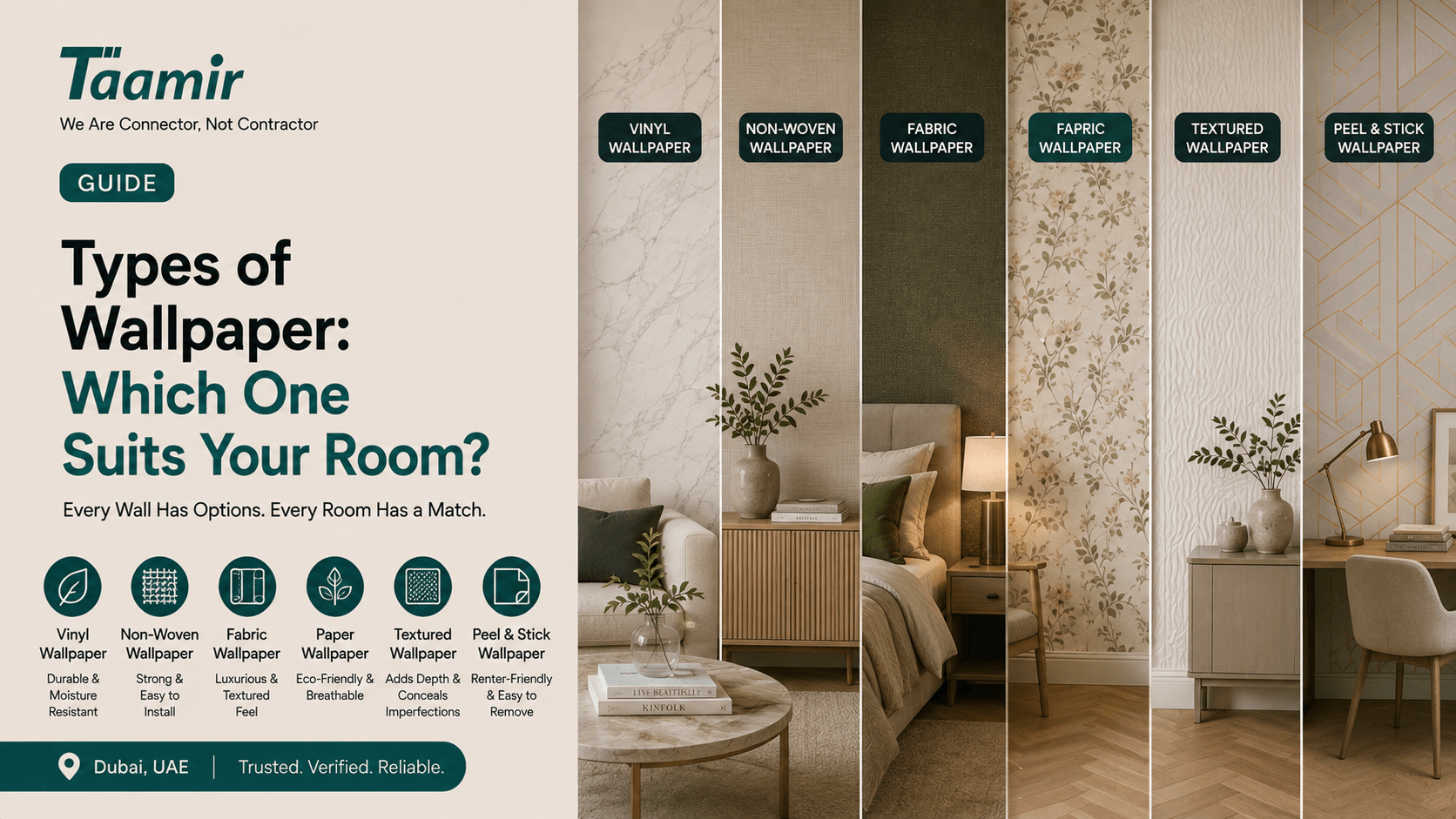
Types of Wallpaper: Which One Suits Your Room?
Wallpaper comes in a handful of main types: non-woven, vinyl and vinyl-coated, natural fibres like grasscloth and silk, textile, peel-and-stick, and murals. They look different, they behave very differently, and the right one depends less on the pattern you like than on the room it is going in — how much moisture it gets, how much traffic, and how often you want to change it.
Most people choose wallpaper by scrolling through patterns. That is the fun part, but it is the second decision. The first is the type, because that is what decides whether the paper still looks good in three years, whether you can wipe a mark off it, and whether it belongs in a bathroom at all. This guide explains each type in plain terms and matches them to rooms, so you can shortlist properly before you compare verified wallpaper professionals on Taamir.
First, understand the two layers
This clears up most of the confusion. Almost every wallpaper has a backing and a surface:
The backing is what sits against the wall. It decides how the paper is hung and how easily it comes off later.
The surface is what you see and touch. It decides the look, and whether the paper can be wiped clean.
So a paper can have a non-woven backing with a vinyl surface — hung like a non-woven, cleaned like a vinyl. When a shop or an installer describes a wallpaper, they are usually talking about one layer or the other. Asking "what is the backing, and what is the surface?" gets you a much clearer answer than asking what it is made of.
The main types
Non-woven
The everyday standard, and the safe default for most rooms. It is made from blended natural and synthetic fibres, which makes it stable — it does not shrink or expand much, so seams stay tight.
Why people like it: easy to hang, breathable, and it usually strips off in whole sheets when you eventually change it.
Where it works: bedrooms, living rooms, dining rooms, home offices, hallways.
Watch for: it takes light wiping, not scrubbing. If a room needs a properly washable surface, choose vinyl instead.
Vinyl and vinyl-coated
The tough one. A plastic-based surface is bonded over a paper or non-woven backing, which makes it water-resistant and genuinely washable.
Why people like it: it wipes clean, handles steam and splashes, and stands up to daily knocks.
Where it works: kitchens, powder rooms, hallways, family rooms, anywhere with children.
Watch for: quality varies a lot. Cheaper vinyl can look flat and plasticky, while good vinyl can convincingly copy fabric, plaster or wood.
Natural fibres — grasscloth, jute, silk
The most beautiful, and the most delicate. Real plant or silk fibres are woven and bonded to a paper backing, giving a texture no print can imitate.
Why people like it: genuine depth and warmth, and every panel is slightly different.
Where it works: bedrooms, formal living rooms, studies — dry rooms with low traffic.
Watch for: it cannot be wiped with water, which marks it permanently. Seams are visible by design, and colour varies naturally between panels, so it needs an installer who has handled it before. Not for bathrooms or kitchens.
Textile and fabric-backed
Fabric such as linen or a woven blend bonded to a backing. It behaves much like natural fibre — a premium look, and the same care required.
Where it works: bedrooms and formal rooms.
Watch for: dusting and gentle vacuuming only. Treat it as delicate.
Peel-and-stick (removable)
A self-adhesive backing instead of paste. It has improved a lot, and current products copy grasscloth, linen and mural designs convincingly.
Why people like it: no paste, no soaking, and it comes off cleanly. Ideal if you rent, or if you like changing a room.
Where it works: bedrooms, home offices, feature walls, kids' rooms, rented apartments.
Watch for: it needs a smooth, clean, fully cured wall. Textured, porous or freshly painted surfaces are where it lifts at the edges. For a permanent installation in a main room, a professionally hung traditional paper still gives a better finish and lasts longer.
Murals and panoramic designs
Not a material so much as a format: one large image printed across several drops to cover a whole wall. Murals come on most backings, commonly non-woven.
Why people like it: one wall carries the whole room, so everything else can stay simple.
Where it works: living rooms, bedroom feature walls, dining rooms, entrance halls.
Watch for: the panels must be hung in the right order and lined up exactly, with no room for error. This is the type where a professional installer matters most.
Textured and embossed finishes
Also a finish rather than a separate material. The surface is raised — plaster effects, weaves, geometric relief — and it catches light and shadow through the day.
Why people like it: depth without pattern, and it hides small imperfections in the wall.
Watch for: the raised surface holds more dust, so it needs regular light dusting with a soft brush.
Which type for which room
Bedroom — non-woven for a simple, calm finish; natural fibre or textile if you want real texture; peel-and-stick if you like changing things.
Living room — non-woven, a mural for a feature wall, or textured for depth.
Hallway and entrance — vinyl, because this is where walls get touched, brushed past and scuffed.
Kitchen — vinyl only, away from the immediate splash zone behind the hob and sink.
Powder room (no shower) — a great place to be bold. Vinyl is the practical choice.
Bathroom with a shower — use vinyl, keep it well away from the shower zone, and make sure extraction works. Directly around a shower, tile is the right material.
Kids' room — vinyl for washability, or peel-and-stick so it can change as they grow.
Home office — texture behind you looks noticeably better on video calls than a flat wall.
You do not have to choose wallpaper for a whole room, either. Papering one wall and painting the rest is a common and effective approach — just have your painting professional work to the same palette rather than matching colours by eye afterwards.
Pattern repeat: the practical bit
One thing worth knowing before you order. A repeat is the distance before the pattern starts again. Each new drop has to be cut so the pattern lines up with the last one, and that cutting creates offcuts — so a large repeat needs more material than a plain or small-repeat design covering the same wall.
Two rules follow: order everything at once from the same production batch, because colour shifts slightly between batches; and order a surplus, so you finish the job and keep a spare piece for invisible repairs later.
Ask about low-emission adhesive
A question almost nobody asks, and an easy one. Wallpaper and its adhesive sit on a large surface in a room you sleep or relax in, so it is reasonable to ask for low-emission products — the same principle behind indoor air quality standards in Dubai Municipality's Al Sa'fat green building system, which covers low-emission materials among its criteria. It matters most in bedrooms and children's rooms, and any good installer will have an answer.
What to ask before you buy
What is the backing, and what is the surface?
Can it be wiped, and with what? "Washable" and "wipeable" are not the same as "scrubbable".
Is it right for this specific room — the moisture, the traffic, the light?
What is the pattern repeat, and how much extra should I order?
Are all the rolls from the same batch?
Does it need a professional installer? Murals, natural fibres and large repeats usually do.
How Taamir fits in
The type you choose changes how the paper is hung, so it is worth talking to an installer before you buy rather than after. On Taamir you can compare verified wallpaper professionals side by side, check their quality signals and past work, and contact them directly — every listed provider passes Taamir's checks before you see them. Three things worth asking each one: whether they have hung your chosen type before, especially murals and natural fibres; whether wall preparation and priming are included in the quote; and how they handle pattern matching and seams. Taamir takes no commission, so the quote reflects the work. If you want the pattern and palette settled first, an interior designer is the right first call — and the AI Cost Estimator will give you a scope of work and a price range in a few minutes.
Frequently Asked Questions
What are the main types of wallpaper?
Non-woven (the everyday standard), vinyl and vinyl-coated (washable and water-resistant), natural fibres such as grasscloth and silk (beautiful but delicate), textile, peel-and-stick (removable), and murals. Textured and embossed designs are finishes that can come on several of these backings.
Which wallpaper is best for a bathroom or kitchen?
Vinyl or vinyl-coated, because the surface resists moisture and can be wiped. Keep it away from the immediate splash zones behind a hob or around a shower, and make sure extraction works properly. Natural fibres should never be used in these rooms.
What is the difference between non-woven and vinyl wallpaper?
Non-woven describes the backing — a stable fibre blend that is easy to hang and usually strips off cleanly. Vinyl describes the surface — a plastic-based layer that makes the paper washable and water-resistant. A wallpaper can have a non-woven backing and a vinyl surface, which gives you both.
Is peel-and-stick wallpaper any good?
Much better than it used to be. Current products copy grasscloth, linen and murals convincingly and remove cleanly, which makes them ideal for rentals and for anyone who likes changing a room. They need a smooth, clean, fully cured wall — that is where most problems start.
Which wallpaper types need a professional installer?
Murals, large pattern repeats, and natural fibre or textile papers. Murals must be hung in sequence and lined up exactly, and delicate papers mark easily and show every misaligned seam. A simple peel-and-stick feature wall is the one most people can manage themselves.
How does Taamir help me choose wallpaper?
Taamir lets you compare verified wallpaper professionals in one place, check their quality signals and past work, and contact them directly with no commission on your quote. Speaking to an installer before you buy is worth it — you can confirm whether they have hung your chosen type before, whether preparation and priming are included, and how they handle pattern matching.
Choose the type first, then the pattern
Get the type right for the room and almost everything else falls into place — the cleaning, the lifespan and the finish. Find and compare verified wallpaper professionals on Taamir, check their quality signals, and contact them directly — no commission, no hidden charges.