The Best Outdoor Flooring for Dubai Homes — Terraces, Gardens, Pool Areas & Balconies
In This Guide
1. Why Outdoor Flooring in Dubai Is a Different Problem
2. The Four Tests Every Dubai Outdoor Floor Must Pass
3. Porcelain Tile — The Gold Standard for Dubai Outdoors
4. Natural Stone — Travertine, Limestone, and Granite
5. Marble Outdoors — Beautiful but Demanding
6. Composite Decking — The Wood Look Without the Wood Problems
7. Concrete and Exposed Aggregate
8. What Fails Outdoors in Dubai
9. Area-by-Area Recommendations
10. Anti-Slip, Drainage, and Safety
11. Maintenance Guide for Dubai Outdoor Floors
12. Cost Guide for Outdoor Flooring in Dubai (2025)
13. Frequently Asked Questions
1. Why Outdoor Flooring in Dubai Is a Different Problem
Outdoor flooring in almost every other market deals with cold, frost, rain, and the occasional heat. In Dubai the challenge is almost entirely the opposite — relentless sun, extreme heat, and an absence of the regular rainfall that in cooler climates actually helps clean and cool outdoor surfaces. The Dubai outdoor floor faces a unique combination of stresses that most flooring manufacturers in Europe, North America, and Asia do not design for as their primary use case.
Surface temperature is the first and most important factor. On a clear Dubai afternoon in July, a dark-toned stone or tile surface exposed to direct sun can reach 75 to 80°C. Even light-coloured surfaces regularly hit 60°C. At these temperatures, materials that are not rated for thermal stability will expand, crack at their joints, delaminate from adhesives, or degrade at the surface. Any adhesive, grout, or waterproofing membrane used in the installation must also be rated for these temperatures — many products designed for European climates are not.
UV radiation is the second major factor. Dubai sits at a latitude and altitude that delivers some of the most intense solar UV radiation of any major city in the world. Materials that are not UV-stable will bleach, fade, or become brittle within one to two seasons. This rules out most polymers, composites, and surface coatings that are not specifically formulated for Gulf conditions.
Sand and dust are the third factor. The fine desert dust that coats outdoor surfaces in Dubai is highly abrasive. On soft or textured surfaces it accumulates in crevices and acts as a grinding compound under foot traffic. Outdoor floors must be either easy to clean completely — smooth enough that dust does not embed — or robust enough that the abrasion causes no meaningful surface degradation.
Finally, drainage matters more in Dubai than in most cities precisely because rain is rare. When it does rain — typically brief but heavy storms between November and March — a terrace or garden floor that drains poorly will pool water that takes days to evaporate in the cooler, lower-evaporation winter weather. Pools of standing water attract insects and cause surface staining, and if the floor was not laid with adequate falls to drain, remediation is expensive.
Find and compare outdoor flooring professionals on Taamir →
2. The Four Tests Every Dubai Outdoor Floor Must Pass
Before selecting any outdoor flooring material for a Dubai property, it should be evaluated against four non-negotiable performance criteria. These are not aspirational standards — they are the baseline below which no outdoor floor in Dubai should be specified.
Thermal Stability
The material must not crack, warp, delaminate, or degrade under sustained surface temperatures of 60 to 80°C. This rules out most standard adhesives, all polymer-core products designed for interior use, and any natural material that has not been confirmed by the supplier as suitable for Gulf outdoor conditions. The adhesive and grout used in the installation must meet the same standard — a thermally stable tile on a standard adhesive that softens at 50°C will eventually fail at the bond line.
UV Stability
The material must retain its colour, surface integrity, and structural properties under sustained, intense UV exposure. In Dubai, UV degradation that might take ten years in northern Europe can occur in two to three seasons. Materials must either be inherently UV-stable — natural stone, fired porcelain — or must be treated with coatings that are themselves UV-stable and periodically renewed.
Anti-Slip Under Wet Conditions
Dubai rain is infrequent but the floors it lands on are rarely designed for it. Pool areas are wet by design year-round. An outdoor floor that is safe when dry and dangerous when wet is a liability. Every outdoor floor must achieve a minimum R11 slip resistance rating for terraces and covered outdoor areas, and R12 for pool surrounds and any area adjacent to water features. This is a safety requirement, not a preference.
Drainage Compatibility
The floor must be laid with adequate falls — a minimum of one percent gradient, ideally two percent — toward drainage outlets, and the drainage capacity must be designed to handle the peak rainfall rates that Dubai experiences in its wet season storms. A terrace that drains perfectly in light rain but pools in a heavy storm is inadequately designed. Any outdoor flooring project should address drainage design as part of the scope, not as an afterthought.
Find and compare outdoor flooring specialists who understand Dubai conditions on Taamir →
3. Porcelain Tile — The Gold Standard for Dubai Outdoors
Porcelain tile rated for exterior use is the most reliable, most widely available, and most design-versatile outdoor flooring material for Dubai properties. When specified correctly — exterior-rated, with an appropriate anti-slip finish and installed on the right adhesive system — porcelain performs extraordinarily well in the Dubai outdoor environment and requires less maintenance than any alternative.
The key specification requirement is the frost-resistance rating, which in the porcelain industry is the proxy for thermal stability — frost-resistant porcelain has a water absorption rate below 0.5 percent and dimensional stability across extreme temperature ranges. Despite Dubai having no frost, frost-resistant porcelain is what you need outdoors here precisely because its thermal stability is what makes it survive the heat cycles. A tile not rated as frost-resistant — even if it performs well indoors — may crack or delaminate within one to two years on a Dubai terrace exposed to full sun.
Large Format Porcelain Outdoors
The large-format tile trend that has dominated Dubai interiors has extended outdoors, and for good reason. Tiles of 60 by 120 cm and above create a terrace surface that is visually expansive, with minimal grout lines and a contemporary quality that smaller tiles cannot achieve at the same scale. For a Dubai villa terrace of 50 sqm or more, large-format porcelain in a natural stone visual — travertine, limestone, or concrete look — creates an outdoor floor that reads as a seamless extension of the interior.
Large format tiles outdoors require a particularly stable substrate and skilled installation to ensure they are fully bedded with no hollow spots beneath — any void in the adhesive bed creates a stress point that can cause the tile to crack under thermal expansion or point load from furniture. Spot-fixing large outdoor tiles is not acceptable — full-bed adhesive application is essential.
Best Visual Designs for Dubai Outdoor Porcelain
• Travertine look — warm, sandy tones with the organic texture of natural stone. The most popular outdoor tile aesthetic in Dubai villa gardens and terraces. Works equally well in covered and uncovered areas.
• Limestone look — similar warmth to travertine but with a more uniform, less textured surface. Clean and contemporary.
• Concrete look — grey, industrial, and modern. Very popular on contemporary villa rooftop terraces and apartment balconies.
• Marble look — white or veined surfaces for covered outdoor areas, pergolas, and shaded terraces. Not recommended for full-sun areas where the surface temperature becomes prohibitive.
• Wood look — porcelain in a timber plank visual, typically 20 by 120 cm or 30 by 150 cm. Very popular for pool surrounds and garden areas where the warmth of wood is desired without wood's maintenance demands.
Anti-Slip Specification for Outdoor Porcelain
No outdoor tile in Dubai should be specified below R11 slip resistance. For pool surrounds, R12 is the correct minimum. Many of the most attractive outdoor tile ranges are available in both a polished interior version and a textured, anti-slip exterior version — always specify the exterior version for any area that will be walked on.
Cost in Dubai (2025 Estimate)
• Mid-grade exterior porcelain, 60 by 60 cm: AED 80 to 140 per sqm supply and install.
• Large-format exterior porcelain, 60 by 120 cm: AED 140 to 240 per sqm.
• Premium Italian exterior porcelain: AED 220 to 400 per sqm.
Find and compare outdoor tile installation professionals on Taamir →
4. Natural Stone — Travertine, Limestone, and Granite
Natural stone has been used underfoot on outdoor terraces, courtyards, and garden pathways in the Gulf for centuries. Its thermal mass — the ability to absorb and release heat gradually — means it does not reach the extreme surface temperatures of denser, less porous materials. Its natural variation in colour and texture gives outdoor spaces a quality and character that no manufactured material can fully replicate. And in a market where authenticity and prestige matter, natural stone carries a weight that porcelain tile, however convincing, cannot.
Travertine
Travertine is the most widely used natural stone for outdoor applications in Dubai. Its warm, sandy tones with subtle colour variation feel at home in the desert landscape, and its naturally pitted, open texture — when the voids are left unfilled rather than filled and honed as for interior use — provides inherent anti-slip properties without any additional treatment. Travertine stays cooler underfoot than denser stones because its open structure limits heat conductivity, which is a genuine comfort advantage on a Dubai pool terrace.
For outdoor Dubai use, travertine should be specified in a brushed or tumbled finish rather than polished or honed. The brushed finish provides the anti-slip texture required for exterior use while retaining the warmth and character of the stone. Travertine must be sealed for outdoor use with a penetrating sealant rated for exterior conditions and re-sealed annually in the Dubai environment.
Limestone
Limestone offers a cleaner, more uniform appearance than travertine while retaining the natural stone warmth and character. In Dubai outdoor spaces, limestone in a bush-hammered or sawn finish is particularly effective — the textured surface provides anti-slip properties while the stone's natural warm grey or beige tones create a contemporary outdoor palette. Limestone is used extensively on the terraces and pool surrounds of Dubai's most prestigious villa communities.
Like travertine, outdoor limestone requires annual sealing. It is also sensitive to the acidic cleaning products sometimes used in Dubai outdoor maintenance — always use pH-neutral cleaners on natural stone outdoor floors.
Granite
Granite is the hardest and most dense of the commonly available natural stones and the most resistant to scratching, staining, and abrasion. In outdoor Dubai applications, granite's durability makes it the preferred choice for high-traffic areas — entrance paths, driveways, and heavily used terraces — where softer stones would show wear. Its density also means it is less porous than travertine or limestone and requires less frequent sealing. The trade-off is that granite surfaces reach higher temperatures in direct sun than the more porous alternatives, and polished granite is extremely slippery when wet. For outdoor use, always specify a flamed, bush-hammered, or sandblasted granite finish.
Cost in Dubai (2025 Estimate)
• Outdoor travertine, brushed or tumbled: AED 120 to 220 per sqm.
• Outdoor limestone, bush-hammered: AED 150 to 280 per sqm.
• Outdoor granite, flamed finish: AED 180 to 320 per sqm.
Find and compare natural stone outdoor flooring professionals on Taamir →
5. Marble Outdoors — Beautiful but Demanding
Marble is one of the most aspirational materials in Dubai residential design, and the desire to extend its use from interior spaces onto terraces and pool surrounds is entirely understandable. A seamless transition from an interior marble floor through floor-to-ceiling glass doors onto an outdoor terrace in matching marble is among the most compelling design moves available in a Dubai villa. But marble outdoors in Dubai is a demanding specification that requires a clear understanding of its limitations before committing to it.
The primary challenge is that marble is porous and acid-sensitive. Outdoor exposure in Dubai means the marble surface must contend with rain water — which is slightly acidic — bird droppings, which are highly acidic and stain rapidly, sand abrasion, and the UV radiation that can cause surface discolouration in some marble varieties over time. Without rigorous sealing and maintenance, outdoor marble deteriorates faster in Dubai than almost anywhere else.
The second challenge is heat. Dark-veined white marbles — Calacatta, Carrara — reflect the majority of solar radiation and stay relatively cool in direct sun, which is part of their appeal for pool surrounds and terraces. But even white marble reaches surface temperatures that can cause thermal stress at grout lines and tile edges over years of cycling between the day's peak heat and the cool of air-conditioned interior air drifting outward through open doors.
Where Marble Works Outdoors in Dubai
Marble is best used in covered outdoor areas — pergolas, shaded terraces, loggia — where it is protected from direct UV radiation and rain. In these conditions, with the right finish — honed or brushed, never polished — adequate drainage, epoxy grout, penetrating sealant applied professionally, and annual re-sealing, marble can perform well and look exceptional for many years. For fully exposed pool surrounds and garden terraces, the maintenance commitment is significant enough that natural stone alternatives or exterior porcelain in a marble visual are often the more practical recommendation.
Cost in Dubai (2025 Estimate)
• Outdoor marble, covered areas, honed finish: AED 200 to 400 per sqm.
• Annual professional sealing for outdoor marble: AED 20 to 40 per sqm.
Find and compare marble flooring professionals on Taamir →
6. Composite Decking — The Wood Look Without the Wood Problems
Real timber decking is rarely the correct choice for exposed outdoor areas in Dubai. Solid hardwood decks — iroko, teak, merbau — that perform adequately in European outdoor conditions deteriorate rapidly under the combination of intense UV radiation, extreme surface heat, and the drying effect of Dubai's low-humidity air for most of the year. Without relentless maintenance — oiling every two to three months rather than once or twice annually as in cooler climates — real timber decking in a Dubai outdoor area will grey, crack, splinter, and warp within a few years. Many Dubai homeowners who specified real timber decking on villa terraces and rooftops have replaced it with composite within five years.
Composite decking solves most of these problems. It is manufactured from a mixture of wood fibre and polymer — typically PVC or polyethylene — which gives it the visual warmth and grain character of real wood while delivering significantly better performance against UV radiation, moisture, and the thermal cycling that destroys solid timber. Quality composite decking from reputable manufacturers is UV-stabilised, will not rot, requires no oiling, and can be cleaned with water and a brush.
Capped vs. Uncapped Composite
The critical distinction in composite decking quality is whether the board is capped or uncapped. An uncapped composite board — in which the wood fibre and polymer are blended throughout the board cross-section — absorbs moisture into the wood fibre component and can fade significantly under UV exposure. A capped composite board has a protective polymer shell applied to all four sides that seals the wood fibre from moisture and UV. For Dubai outdoor conditions, capped composite is the only appropriate specification. Uncapped composite boards are designed for temperate climates and will underperform significantly in Gulf conditions.
Heat Retention
The most significant limitation of composite decking in Dubai is heat retention. Composite boards — particularly dark-coloured ones — can reach very high surface temperatures in direct sun, making the deck surface uncomfortable and even painful to walk on barefoot during summer. For Dubai pool terraces and garden decks where barefoot use is expected, lighter composite colours and adequate shading are essential design considerations. Some homeowners specify composite for shaded areas and porcelain or natural stone for sun-exposed pool surrounds to manage this.
Best Applications for Composite Decking in Dubai
• Covered terraces and pergola areas where direct sun exposure is limited.
• Rooftop terraces with adequate shading structures.
• Garden seating areas and outdoor dining zones.
• Balconies of apartments and townhouses.
• Any outdoor area where the warmth and texture of wood underfoot is a priority and some shading is available.
Cost in Dubai (2025 Estimate)
• Entry-level composite decking (uncapped): AED 120 to 180 per sqm — not recommended for Dubai.
• Mid-range capped composite decking: AED 200 to 320 per sqm.
• Premium capped composite, wide board: AED 320 to 500 per sqm.
Find and compare outdoor flooring professionals on Taamir →
7. Concrete and Exposed Aggregate
Poured concrete and exposed aggregate finishes have become increasingly popular in contemporary Dubai outdoor spaces, particularly in villa gardens, driveways, and modern rooftop terrace designs. Their appeal is their seamlessness, their cost-effectiveness at scale, and the industrial quality that suits the contemporary architectural aesthetic dominant in new Dubai villa communities.
Poured Concrete Outdoors
Poured concrete outdoors in Dubai must be formulated for the local climate — a higher cement-to-water ratio than standard mixes, with appropriate plasticisers and curing agents to prevent surface cracking as the concrete dries rapidly in the Gulf heat. Unmodified concrete poured in Dubai summer temperatures without proper curing measures will crack at the surface within weeks. Once properly poured and cured, concrete can be finished in several ways — broom-finished for basic anti-slip texture, exposed aggregate for decorative texture and grip, polished for a smooth contemporary look in covered areas, or stained and sealed for colour.
Concrete outdoors requires sealing with a penetrating sealer and periodic re-sealing — typically every two to three years — to prevent staining and moisture penetration. Oil from vehicles, bird droppings, and food spills stain unsealed concrete rapidly and permanently.
Exposed Aggregate
Exposed aggregate finishes — in which the surface layer of concrete is removed while still green to reveal the aggregate stones beneath — produce a naturally textured, anti-slip surface with excellent drainage characteristics. The aggregate can be selected for colour and character, from standard grey gravel to white pebble, coloured stone, and even recycled glass. Exposed aggregate is one of the most cost-effective ways to create a large outdoor surface in Dubai that is anti-slip, durable, and visually interesting. It is widely used on driveways, garden paths, and utility outdoor areas.
Cost in Dubai (2025 Estimate)
• Basic poured and broom-finished concrete: AED 60 to 100 per sqm.
• Exposed aggregate concrete: AED 90 to 160 per sqm.
• Polished or stained decorative concrete, covered areas: AED 150 to 280 per sqm.
Find and compare outdoor flooring professionals on Taamir →
8. What Fails Outdoors in Dubai
Understanding what not to install in a Dubai outdoor space saves money, time, and significant frustration. The following materials are installed in Dubai outdoor areas every year by homeowners and contractors who underestimate the Gulf climate — and the results are consistently poor.
Standard Interior Porcelain and Ceramic Tile
Interior porcelain tile — even high-quality large-format product — is not rated for the thermal stress of full outdoor sun exposure in Dubai. Interior tiles are manufactured to dimensional tolerances appropriate for climate-controlled indoor environments. In full outdoor exposure, the expansion and contraction caused by daily heating and cooling cycles causes grout lines to crack, tiles to debond from adhesive, and in some cases tiles to crack across the body. Always specify exterior-rated, frost-resistant porcelain for any outdoor application.
See outdoor-rated tile options on Taamir →
SPC and LVP Vinyl Flooring
SPC and luxury vinyl plank products are excellent indoor floors but are not designed for outdoor use in Dubai. Their polymer cores soften and deform at the surface temperatures reached on a Dubai terrace in summer. UV radiation degrades the wear layer and print layer rapidly, causing fading and brittleness within one to two seasons. No vinyl flooring product should be installed in any outdoor area exposed to Dubai sun.
See SPC vinyl for indoor applications on Taamir →
Laminate Flooring
Laminate is unsuitable for outdoor use under any circumstances. It is moisture-sensitive, UV-unstable, and will fail within one season in any Dubai outdoor environment. It should never be considered for outdoor use regardless of price point or manufacturer claims.
See laminate flooring for indoor applications on Taamir →
Solid Hardwood and Engineered Wood
Solid timber decking fails rapidly in Dubai outdoor conditions without maintenance that is not practical for most homeowners. Engineered wood flooring — designed for interior climate-controlled environments — is entirely inappropriate for outdoor use and will fail within months if exposed to direct sun and moisture outdoors.
See parquet and wood flooring for indoor applications on Taamir →
Epoxy Coatings Outdoors
Standard epoxy floor coatings are not UV-stable. In outdoor Dubai conditions, an unmodified epoxy surface will yellow, chalk, and become brittle within one to two seasons. For outdoor concrete areas requiring a sealed, hardened surface, UV-stable polyurethane coatings are the appropriate product — not standard epoxy. If epoxy is specified for outdoor use, it must be a UV-stabilised formulation specifically rated for outdoor conditions, which is a specialist product not always available from standard flooring contractors.
See epoxy flooring for indoor and garage applications on Taamir →
Micro Cement Outdoors
Micro cement is an interior finish material. It is not rated for the UV exposure, thermal cycling, or moisture conditions of outdoor Dubai environments and will deteriorate rapidly if used outdoors.
See micro cement for indoor applications on Taamir →
9. Area-by-Area Recommendations
Villa Garden Terrace
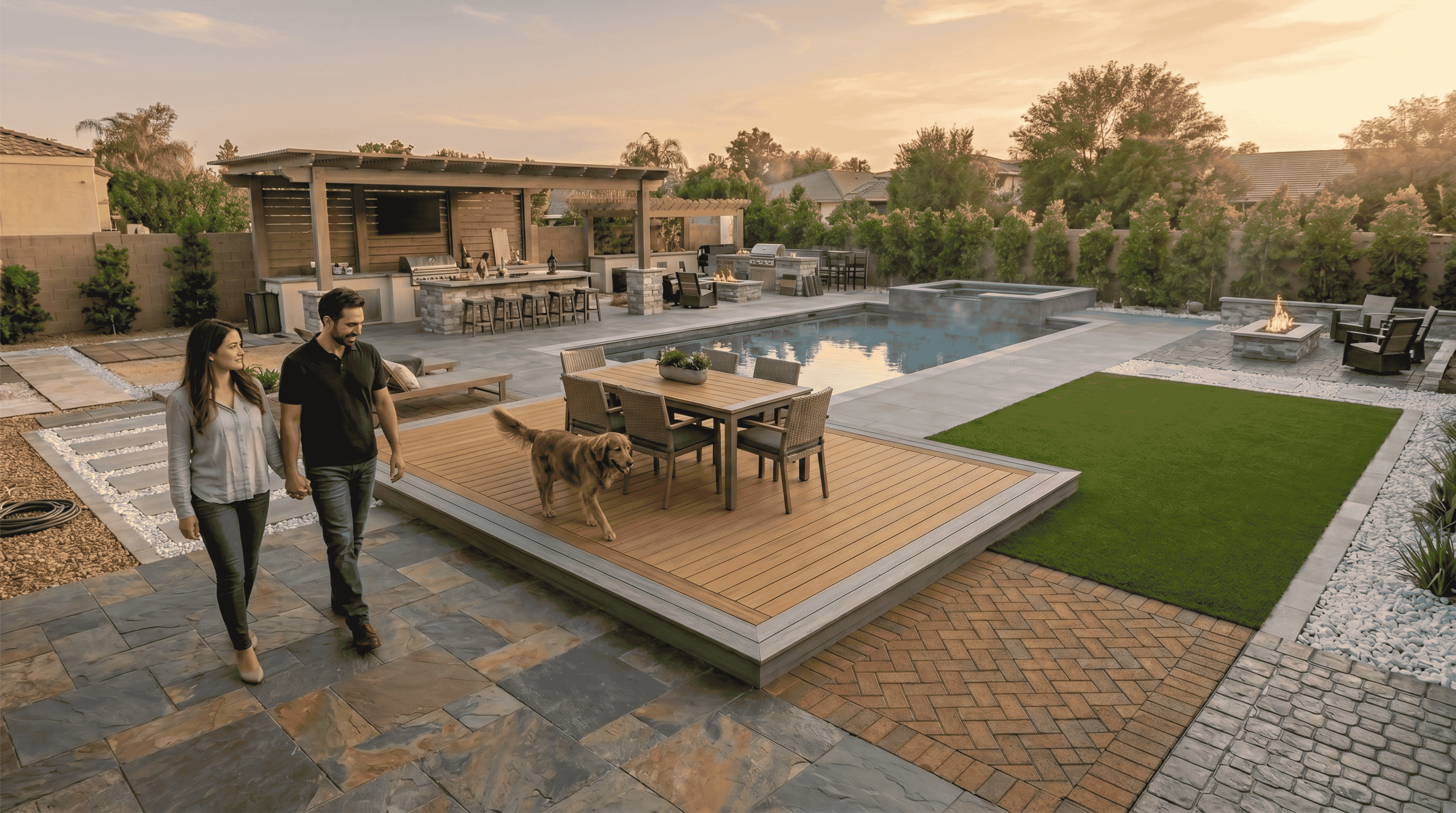
The main terrace of a Dubai villa — typically adjacent to the living room and opening onto the garden — is one of the highest-visibility outdoor spaces on the property and warrants the most considered flooring specification. Large-format exterior porcelain in a travertine or limestone visual is the dominant choice in the Dubai villa market, and it delivers well: visually expansive, low maintenance, anti-slip, and compatible with the indoor tile or stone flooring it typically borders. Natural travertine or limestone is the premium alternative for those who want the authenticity of real stone and are committed to the maintenance it requires.
Pool Surround
The pool surround is the most demanding outdoor flooring application in Dubai. It is wet by design, walked on barefoot, and in full sun for most of the day. The anti-slip requirement is absolute — R12 is the minimum. Surface temperature is a critical comfort factor — light-coloured materials with some porosity or texture stay cooler than dense, dark, highly polished surfaces. The best performing materials for Dubai pool surrounds are brushed or tumbled travertine — cool, naturally anti-slip, and beautiful in the aquatic context — and exterior porcelain in a travertine or limestone visual with a textured, R12-rated finish. Composite decking is an option for shaded pool terraces where direct sun exposure is limited.
Rooftop Terrace
Rooftop terraces in Dubai apartments and villas face the most extreme version of the outdoor Dubai climate — full sun from above, heat radiating up from the roof deck below, and no shade unless a pergola or shade sail is installed. The substrate is typically a waterproofed concrete roof slab that must not be compromised by the flooring installation above it. Large-format exterior porcelain on a pedestal system — raised on adjustable feet above the waterproof membrane — is the preferred specification for Dubai rooftop terraces because it allows drainage beneath the tiles, protects the waterproofing from UV degradation, and allows inspection and maintenance of the membrane without full tile removal. Composite decking on pedestals is a popular alternative where the warmth and texture of a timber surface are priorities.
Balcony
Apartment and villa balconies in Dubai are typically smaller, partially shaded, and covered by the floor structure above. They receive less direct sun than exposed terraces and pool surrounds, which broadens the material options somewhat. Exterior porcelain is still the most reliable choice. Composite decking is very popular on Dubai apartment balconies where the timber aesthetic is desired and the shading provided by the building structure limits peak surface temperatures. Balcony floors must always be laid with a fall toward drainage to prevent water pooling after rain or irrigation overspray.
Garden Pathway and Driveway
Garden pathways and driveways in Dubai properties require materials that can handle vehicle loads where applicable, maintain their anti-slip properties under the fine sand and dust that settles constantly, and resist staining from the organic matter that accumulates in garden environments. Exterior porcelain, granite with a flamed finish, and exposed aggregate concrete are the most appropriate choices. Stepping stones in natural travertine or limestone are popular in villa garden designs for their organic, relaxed quality.
Outdoor Staircase
Outdoor staircases in Dubai require particular attention to anti-slip specification. A stair nosing — the leading edge of each tread — must be clearly defined and anti-slip regardless of the material used for the rest of the tread. Stair treads should meet R11 as an absolute minimum, and R12 where the staircase is exposed to rain or pool splash. Natural stone with a flamed or bush-hammered finish is the most reliable choice for outdoor stair treads. Exterior porcelain with a factory-applied anti-slip finish and integrated nosing profile is the alternative.
Find and compare outdoor flooring professionals for every area on Taamir →
10. Anti-Slip, Drainage, and Safety
Anti-Slip Ratings for Outdoor Dubai Areas
• R10 — minimum for covered outdoor areas with no water exposure. Not appropriate for pool surrounds or areas exposed to rain.
• R11 — minimum for exposed outdoor terraces, balconies, and any area that will be wet from rain or irrigation.
• R12 — minimum for pool surrounds, outdoor showers, and splash zones around water features.
• R13 — appropriate for areas with sustained standing water. Rarely required in residential applications.
Drainage Design
Every outdoor floor installation in Dubai must include a documented drainage design — not just a fall toward a gully, but a calculation of drainage capacity against peak rainfall rates. Dubai receives the majority of its annual rainfall in a handful of intense storms during the winter months. Peak rainfall rates during these events regularly exceed the drainage capacity of outdoor floors designed only for light, distributed rain. Linear drains along the perimeter of a large terrace, combined with adequate gradient, are the professional standard for Dubai outdoor flooring installations.
Thermal Comfort
Beyond slip resistance, the surface temperature of an outdoor floor is a safety and comfort factor in Dubai. A pool surround that reaches 70°C in direct sun is not just uncomfortable — for children and elderly residents, contact with a surface at that temperature can cause burns. Light-coloured materials with some surface porosity — travertine, light limestone, pale textured porcelain — stay significantly cooler in direct sun than dense, dark, smooth materials. Shade structures over key outdoor areas are the most effective mitigation, but material selection also contributes meaningfully to thermal comfort.
Find outdoor flooring professionals who design for Dubai conditions on Taamir →
11. Maintenance Guide for Dubai Outdoor Floors
Dubai's outdoor environment is hard on every material. Sand, dust, hard water from irrigation systems, bird droppings, and the UV and heat from the sun combine to create a maintenance burden that is higher than most homeowners expect. Understanding the maintenance requirements of each material before installation avoids unpleasant surprises after the project is complete.
Porcelain Tile Outdoor Maintenance
Exterior porcelain with epoxy grout is the lowest-maintenance outdoor flooring option available. It requires periodic hosing down — monthly in most Dubai gardens — and an occasional clean with a pH-neutral outdoor floor cleaner. The most common maintenance issue with outdoor porcelain in Dubai is hard water staining from irrigation systems, which leaves white calcium deposits on the surface. These are removed with a diluted acidic cleaner — white vinegar solution or a purpose-made hard water remover. Epoxy grout does not require sealing. The tiles themselves do not require sealing.
Natural Stone Outdoor Maintenance
Natural stone outdoors in Dubai requires more maintenance than porcelain. Travertine and limestone must be sealed with a penetrating, breathable sealant rated for exterior conditions on installation and re-sealed every twelve months. The sealing prevents the stone from absorbing stains from oil, bird droppings, and organic matter while allowing moisture vapour to pass through — important for stone laid over a waterproofed substrate. Bird droppings must be removed immediately from natural stone outdoors, as the acid in them etches the surface within hours in the Dubai heat. Pressure washing at low pressure — no higher than 1200 psi — is the most effective cleaning method for outdoor natural stone in Dubai.
Composite Decking Maintenance
Quality capped composite decking requires only periodic cleaning with water and a soft brush or pressure washer. Unlike real timber, it does not require oiling, staining, or sanding. The most common maintenance issue in Dubai is mould growth in the grooves between boards in areas that retain moisture — this is addressed with a specialist composite deck cleaner and a stiff brush. Composite boards should be inspected annually for any signs of board movement or fixing failure at the fixing points.
Concrete Outdoor Maintenance
Sealed concrete outdoors requires re-sealing every two to three years in Dubai. The sealant protects against oil and organic staining and reduces the penetration of the acidic rain water that falls during Dubai's wet season. Between re-seals, concrete should be cleaned with a pH-neutral cleaner and rinsed thoroughly. Oil stains on concrete — from vehicles on driveways or from outdoor cooking areas — must be treated with a degreaser immediately, as they set permanently within twenty-four to forty-eight hours in the Dubai heat.
Find outdoor flooring maintenance and installation professionals on Taamir →
12. Cost Guide for Outdoor Flooring in Dubai (2025)
Per Square Metre — Supply and Install
• Exposed aggregate concrete: AED 90 to 160 per sqm.
• Mid-grade exterior porcelain, 60 by 60 cm: AED 80 to 140 per sqm.
• Large-format exterior porcelain, 60 by 120 cm: AED 140 to 240 per sqm.
• Premium Italian exterior porcelain: AED 220 to 400 per sqm.
• Outdoor travertine, brushed or tumbled: AED 120 to 220 per sqm.
• Outdoor limestone, bush-hammered: AED 150 to 280 per sqm.
• Outdoor granite, flamed finish: AED 180 to 320 per sqm.
• Outdoor marble, covered areas only: AED 200 to 400 per sqm.
• Capped composite decking, mid-range: AED 200 to 320 per sqm.
• Premium capped composite decking: AED 320 to 500 per sqm.
Typical Project Costs
• Villa garden terrace, large-format exterior porcelain (80 sqm): AED 15,000 to 30,000.
• Pool surround, brushed travertine (60 sqm): AED 10,000 to 18,000.
• Rooftop terrace on pedestal system, exterior porcelain (50 sqm): AED 18,000 to 35,000.
• Apartment balcony, capped composite decking (15 sqm): AED 5,000 to 10,000.
• Villa driveway, exposed aggregate concrete (100 sqm): AED 12,000 to 22,000.
• Garden pathway, natural limestone stepping stones (20 sqm): AED 5,000 to 12,000.
These are indicative ranges. Costs vary significantly based on material grade, substrate condition, drainage design requirements, pedestal system specification for rooftops, and site access. Waterproofing membrane work — required for rooftop terraces and pool surrounds — is a separate cost typically ranging from AED 50 to 120 per sqm.
Find and compare outdoor flooring professionals — see their previous projects on Taamir →
13. Frequently Asked Questions
What is the best outdoor flooring for a Dubai villa terrace?
Large-format exterior-rated porcelain tile in a travertine or limestone visual with an R11 anti-slip finish is the most reliable, lowest-maintenance, and most design-versatile choice for Dubai villa terraces. For those who want the authenticity of real stone and are committed to annual sealing, brushed or tumbled travertine is the premium natural alternative.
What is the best flooring for a Dubai pool surround?
Brushed or tumbled travertine is the traditional and most widely used pool surround material in Dubai — naturally anti-slip, thermally comfortable, and beautiful in an aquatic setting. Exterior porcelain in a travertine visual with an R12 anti-slip rating is the lower-maintenance alternative. Both are appropriate. Polished marble, composite decking in full sun, and any vinyl or laminate material are not appropriate for pool surrounds.
Can I use composite decking on a Dubai rooftop terrace?
Yes, on a shaded rooftop terrace with adequate drainage design. Capped composite decking on an adjustable pedestal system — which raises the boards above the waterproofing membrane — is a popular rooftop terrace specification in Dubai. It is important that the composite specification is capped on all four sides, UV-stabilised, and in a lighter colour to manage surface temperature. In full, unshaded sun exposure, composite boards can reach uncomfortable surface temperatures in Dubai summer.
Why is my exterior tile cracking on my Dubai terrace?
The most common cause is the use of interior tile or interior-rated adhesive in an outdoor application. Interior tiles are manufactured to dimensional tolerances appropriate for climate-controlled spaces and will crack under the thermal expansion and contraction of outdoor sun exposure. Interior adhesives soften at temperatures below what Dubai outdoor surfaces regularly reach. The fix is to remove all tiles and reinstall with exterior-rated frost-resistant porcelain on a flexible, exterior-rated adhesive system.
Can I install real wood decking outdoors in Dubai?
It is possible, but it requires a maintenance commitment that most homeowners find unsustainable. Real timber decks in Dubai need oiling every two to three months to prevent UV degradation, cracking, and splintering — compared to annually in cooler climates. Most homeowners who start with real timber decking in Dubai replace it with quality capped composite within three to five years. Composite is the more practical outdoor decking specification for Dubai.
What slip resistance rating do I need for my Dubai outdoor floor?
R11 is the minimum for exposed outdoor terraces and balconies. R12 is the minimum for pool surrounds and any area adjacent to water features. Always ask for the R-rating test certificate from your tile supplier before installation — this is a safety specification, not an optional detail.
How do I remove hard water stains from my outdoor tiles in Dubai?
Hard water staining from Dubai's high-mineral-content water supply and irrigation systems appears as white calcium deposits on outdoor tile surfaces. They are dissolved by diluted acidic cleaners — a white vinegar solution works for light deposits, and a purpose-made hard water stain remover from a tile supply shop handles heavier buildup. Do not use acidic cleaners on natural stone — they will etch the surface. For natural stone, use a pH-neutral cleaner and consult a stone care professional for stubborn staining.
Does Taamir cover outdoor flooring in Abu Dhabi and Sharjah?
Yes. On Taamir you can find and compare flooring professionals across Dubai, Abu Dhabi, and Sharjah who specialise in outdoor terraces, pool surrounds, garden areas, and rooftop installations. Browse their profiles and see their previous projects before making a decision.
Find and compare outdoor flooring professionals on Taamir — see previous projects →
Find the Right Professional for Your Outdoor Floor
On Taamir you can browse flooring professionals in Dubai who specialise in outdoor terraces, pool surrounds, balconies, driveways, and rooftop areas. See their previous projects and compare profiles to find the right professional for your outdoor space.
©