Night Gardens: How UAE Villas Are Reclaiming Outdoor Living After Dark
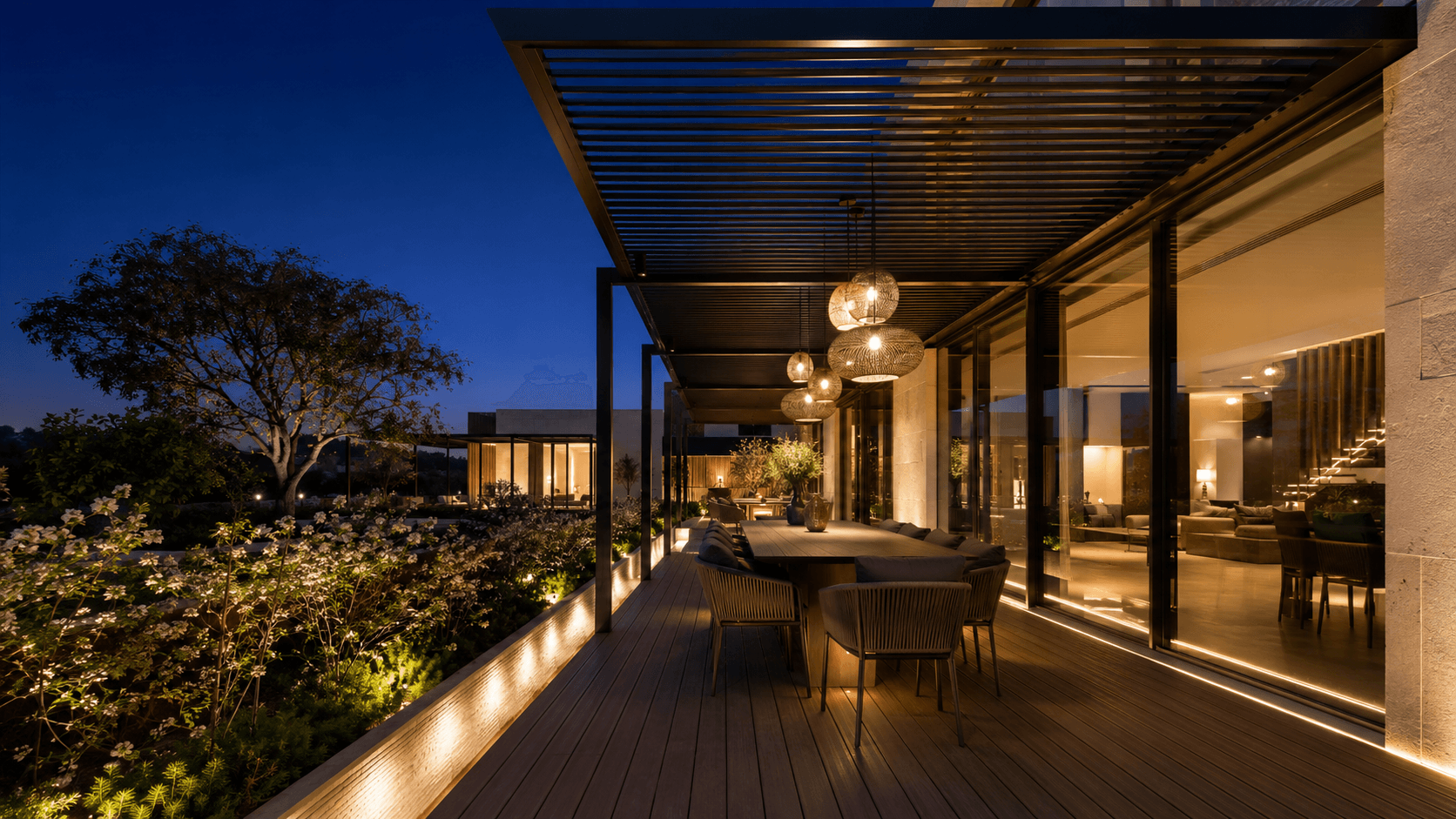
The 8pm truth nobody talks about
Walk through any villa community in Dubai at 2pm in May and you'll see something strange: beautiful gardens, expensive landscaping, and absolutely no one outside. Now come back at 8pm. The sliding doors are open. The kids are on the trampoline. Someone is grilling. The garden is finally being used.
For six months of the year — roughly April through October — UAE outdoor spaces are functionally nocturnal. We don't use our gardens at noon. We use them once the sun has set and the air drops below 35°C. And yet most landscaping in this region is still designed as if it's being viewed from a sunlit conservatory in Surrey.
That's changing fast. A growing number of UAE homeowners are flipping the brief entirely. Instead of asking "what does my garden look like in daylight?", they're asking "what does my garden feel like at night?" The result is a movement quietly transforming villa landscaping across Dubai, Abu Dhabi, and Sharjah: the night garden.
What is a night garden, really?
A night garden isn't a daytime garden with lights bolted onto it. It's a complete reframing of every design decision — from which plants you choose, to which surfaces sit underfoot, to when the irrigation runs and which corner of the property you sit in.
The principle is simple. If 80% of your garden's use happens between sunset and midnight, then 80% of your design budget should serve that window. The temperature is cooler. The light is different. Fragrance carries further. Insects you didn't see at noon become part of the soundscape. White flowers glow. Dark foliage disappears. Materials that stored heat all day continue radiating it long after dusk.
A night garden takes all of that seriously. It's less Mediterranean fantasy, more sensory cinema — designed for the version of you that exists at 9pm with a cold drink, not the version that exists at 1pm in air conditioning.
The bones: hardscaping built for the cool hours
The single biggest mistake in UAE garden design is choosing surface materials by daytime aesthetics. Polished dark stone looks gorgeous in a brochure and stays uncomfortably warm until midnight. Glossy ceramic tile reflects glare during the day and feels strange under bare feet at night. Concrete absorbs heat like a battery.
Night gardens use materials that release heat fast and feel inviting after dark. Timber decking — especially heat-treated hardwoods like Accoya or thermo-ash — drops to ambient temperature within an hour of sunset. Light-coloured interlock pavers reflect rather than store, keeping the underfoot temperature manageable from 7pm onward. Composite decking has come a long way for UAE conditions and now offers UV-stable options that don't splinter and don't burn.
The smartest landscaping contractors in Dubai and Abu Dhabi now layer surfaces by zone: cooler decking around seating and dining areas, lighter pavers for pathways and play zones, and gravel or compacted decomposed granite for transition spaces. The whole property breathes faster after sunset, and that's the point.
The living layer: plants that wake up when the sun goes down
This is where night garden design gets genuinely exciting. Most UAE planting palettes are still pulled from English garden books — the kind compiled by the Royal Horticultural Society for a temperate climate — which is a problem on two fronts: half the plants struggle in our heat, and the other half are at their most beautiful at 11am, when no one is looking.
A night garden flips the planting brief. The hero plants are nocturnal bloomers, white-flowering species, silver foliage, and fragrant evening releasers. Frangipani (plumeria), which scents the air most powerfully after dusk. Moonflower (Ipomoea alba), whose blossoms unfurl literally at sunset. Night-blooming jasmine (Cestrum nocturnum), one of the strongest perfumes in any garden, anywhere. Queen of the night (Epiphyllum oxypetalum). Brugmansia, with its enormous pendant trumpets that glow under landscape lighting.
The supporting cast is just as deliberate. Silver-leafed plants — desert lavender, dusty miller, helichrysum — reflect moonlight and uplighting in a way green foliage can't. White-flowering bougainvillea, oleander, and gardenia hold light long after the sun has gone. Native UAE species like Ghaf, Sidr, and various acacias provide architectural silhouettes that read powerfully against dusk skies and require almost no water once established.
This is also where a proper garden designer earns their fee. The difference between a night garden that works and one that doesn't isn't the plant list — it's the layering. Tall silhouette plants at the back, mid-height fragrants in the middle, low spillers and ground cover at the edges of seating areas where their scent travels. Done well, the garden looks one way at noon and becomes something else entirely after 7pm.
The pergola renaissance
For years the pergola was a builder's afterthought in UAE villa design — a small wooden frame thrown into a corner of the garden to satisfy the brief. Night garden design has completely changed that. The pergola is now the single most important architectural element in many premium UAE outdoor schemes, because it does something nothing else does: it creates a room.
The new generation of UAE pergolas isn't trying to be Tuscan. They're structural, often steel or powder-coated aluminium, with retractable louvres or bioclimatic blades that open at night for stars and ventilation and close during the day for shade. They host the entire evening: lighting strips run along the beams, hanging pendants drop over the dining table, climbing plants like Rangoon creeper or evening-scented stephanotis weave through the structure.
A well-designed pergola turns a 30-square-metre patch of garden into an outdoor living room you'll use 250 nights a year. That's a transformation no other single element offers.
The water hour: why night irrigation changed everything
Here's a quiet truth about UAE landscaping: most gardens are watered at the wrong time. Daytime irrigation evaporates before plants can absorb it. Morning irrigation cooks the leaves it lands on. The correct window in UAE summer is between 9pm and 4am — guidance broadly aligned with conservation advice published by DEWA — and yet most older villa systems are still running on midday timers built for an English climate.
Smart irrigation installation has become the unsung hero of the night garden movement. Modern controllers — paired with soil-moisture sensors and local weather APIs — water only when the soil actually needs it, which in UAE means deep overnight cycles, less frequent than most homeowners think, and never on a rainy day. The result is healthier plants, water bills cut by 30–50%, and irrigation that runs in the cool hours when it actually works.
For a night garden, this isn't optional. The fragrant evening plants — jasmine, frangipani, gardenia — are also the thirstiest. Get the irrigation right and they thrive. Get it wrong and you spend a year wondering why a beautiful design slowly browned.
The family garden after sunset
For families with children, the night garden isn't a lifestyle choice — it's a survival strategy. Kids in UAE can't play outside between 11am and 4pm for half the year. The cool evening hours are when childhood actually happens in this country.
The smartest outdoor play equipment being installed in Dubai and Abu Dhabi right now is designed around this reality. Climbing frames placed under pergolas or mature tree canopies, so they don't bake during the day and aren't blisteringly hot to touch by 5pm. Rubberised soft-fall surfacing in light colours rather than black recycled rubber, which absorbs heat. Trampolines in shaded corners with proper drainage so they can be hosed down. Sand pits with covers to keep cats out and heat in check.
Layering matters here too. A play zone next to a fragrant planting area, separated by a low hedge or run of pavers, lets parents sit and talk while children play. The garden serves three generations in the same hour. That's what a real outdoor living space looks like.
The quiet maintenance of a garden that lives at night
A night garden has a different maintenance rhythm than a daytime one. The hedging, pruning, and bed maintenance still need to happen, but timing and detail shift in subtle ways. Fragrant plants need to be cut back at specific points in the season to maximise evening bloom. White-flowering species need deadheading more carefully because the visual impact depends on the flowers being immaculate against dark foliage. Path lights need cleaning more often than people expect — dust accumulation in UAE can cut light output by half within a few weeks.
This is also where the quality of a gardening and maintenance team really shows. A generic service will mow lawns and trim hedges. A good one will know exactly when your jasmine should be pruned for maximum evening flowering, will spot signs of irrigation issues before they kill a plant, and will time their visits so the garden looks its best when you actually use it — not at 9am when no one's home.
The UAE has world-class garden maintenance available, but the variation between providers is enormous. The single best decision most night garden owners make is locking in a monthly maintenance contract with a team that understands the design intent.
Where to begin
The most common question from homeowners discovering night garden design is "where do I actually start?" The honest answer is: not with the plants. Not with the lighting. Start with the use case.
Stand in your garden at 8pm tomorrow. Notice where the breeze comes from. Notice where you naturally want to sit. Notice which corner the kitchen door opens onto. That's where the pergola and dining zone want to be. Notice where the kids run. That's the play zone. Notice the long view from the seating area — that's where the silhouette planting and uplit feature trees belong.
From there, the right contractor will reverse-engineer the rest: irrigation routes, surface materials, plant selection, lighting circuits, drainage. The whole property starts to make sense as one connected evening environment rather than a collection of disconnected features.
The night garden movement is real, it's growing fast in UAE villa communities, and it's the most exciting thing happening in this region's landscape design in years. The difference between a garden you walk past and a garden you live in is, increasingly, a decision about which version of the day you're designing for.
If your answer is "the version after sunset" — you're already thinking like 2026.
Build yours with Taamir
Looking for verified landscaping, decking, pergola, irrigation, garden design, paving, maintenance, and outdoor play specialists across Dubai, Abu Dhabi, Sharjah, and the wider UAE? Browse vetted providers on Taamir — zero commission, fully verified, ready to quote.
Sources and further reading
Authoritative external references cited throughout this article. Each is linked inline within the relevant section above.
• Royal Horticultural Society — Global authority on horticulture and plant taxonomy. Referenced in the planting section.
• Plumeria (frangipani) — Wikipedia — Botanical reference for the genus, including evening fragrance behaviour.
• Prosopis cineraria (Ghaf) — Wikipedia — Reference for the UAE's national tree and its role in arid-climate landscaping.
• Accoya — Manufacturer reference for acetylated hardwood decking suited to UAE conditions.
• DEWA — Dubai Electricity and Water Authority — Official authority on water and energy conservation guidance for UAE homes.