How to Fix Sagging Closet Shelves and Broken Cabinet Hinges Yourself
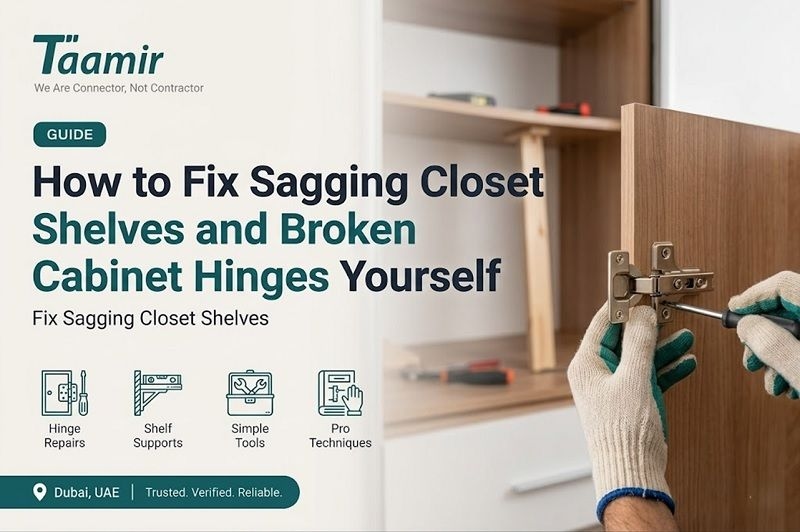
Sagging shelves and failing cabinet hinges are not just cosmetic issues—they are early signs of structural weakness in your storage system. If ignored, they can lead to permanent damage, door misalignment, and even full cabinet replacement.
The good news is that most of these problems can be solved at home without professional help. With the right approach, you can Fix Sagging Closet Shelves, restore stability, and extend the life of your cabinetry significantly.
This guide provides a deeper, more practical breakdown of causes, repair methods, long-term reinforcement strategies, and expert-level DIY techniques.
Why Cabinets and Shelves Fail Over Time
Before attempting repairs, it’s important to understand why these problems happen in the first place. Most failures are gradual and predictable.
1. Structural Load Issues
Shelves are often not designed for the actual weight users place on them.
Heavy books, tools, or storage boxes
Uneven weight distribution
Overloading a single shelf instead of balancing storage
2. Material Weakness
Not all shelving materials are built equally.
MDF absorbs moisture and weakens over time
Particleboard compresses under pressure
Thin plywood bends under long spans
3. Installation Errors
Even strong materials fail if installed incorrectly.
Missing wall studs
Improper bracket spacing
Weak screw anchoring
4. Environmental Factors
Humidity and temperature changes slowly deform materials.
Warping due to moisture
Expansion and contraction cycles
Mold or swelling in hidden areas
Understanding these issues helps you permanently Fix Sagging Closet Shelves instead of applying temporary patches.
How to Fix Sagging Closet Shelves (Complete Methods)
There is no single solution for every case. The correct method depends on severity, material, and shelf length.
Method 1: Heavy-Duty Center Support Installation
This is the most reliable and widely used professional method.
Steps:
Remove all items from the shelf
Measure the exact center point
Install a vertical support (wood or metal)
Secure it into a stud or solid base
Recheck shelf level using a spirit level
Why it works:
It transfers load from the weak board to a strong vertical structure, preventing further bending.
Method 2: Hidden Reinforcement Beam (Advanced DIY)
For a cleaner look without visible brackets.
Steps:
Cut a wooden beam slightly shorter than shelf length
Apply strong wood adhesive
Attach under the front edge of the shelf
Reinforce with countersunk screws
Clamp for at least 24 hours
Best for:
Bedrooms
Living room closets
Visible storage areas
This method is highly effective if you want to Fix Sagging Closet Shelves without changing aesthetics.
Method 3: Full Shelf Replacement (Long-Term Fix)
Sometimes repair is not enough.
Replace if:
Shelf is cracked or split
MDF is swollen or soft
Multiple sag points exist
Upgrade options:
Thick plywood (18mm or more)
Solid wood boards
Metal-supported shelving systems
A replacement ensures structural integrity for years.
Method 4: Wall Anchor Reinforcement
If shelves are wall-mounted, anchors are critical.
Remove old anchors
Drill into studs whenever possible
Use heavy-duty wall plugs
Double-check alignment before loading
Method 5: Load Redistribution Strategy
Even a strong shelf can fail again if misused.
Place heavy items near wall supports
Keep lighter items in center sections
Avoid stacking vertical weight piles
Rotate stored items regularly
Cabinet Hinges: Full Repair Guide
Broken hinges often start as small alignment issues but quickly escalate if ignored.
Tightening and Stabilizing Loose Hinges
Steps:
Open cabinet door fully
Tighten all hinge screws evenly
Check for wobble after each adjustment
Replace missing screws immediately
Fixing Stripped Screw Holes (Professional Trick)
This is one of the most important repair techniques.
Steps:
Remove screw completely
Insert wooden toothpicks or dowel pieces with wood glue
Let it dry fully (minimum 2–4 hours)
Reinsert screw tightly
This restores grip strength inside damaged wood.
Adjusting Misaligned Doors
Cabinet doors often sag due to hinge stress.
Adjustment directions:
Vertical screws → raise or lower door
Horizontal screws → shift left or right
Depth screws → control door closeness
Make small adjustments gradually to avoid overcorrection.
Replacing Hinges Completely
Replace hinges if you notice:
Rust or corrosion
Metal fatigue
Constant loosening
Noise or stiffness
Upgrade recommendation:
Soft-close hinges
Heavy-duty concealed hinges
Stainless steel models for humid environments
Tools for Professional-Level DIY Repair
To properly Fix Sagging Closet Shelves, you should prepare:
Electric drill with multiple bits
Screwdriver set (flat + Phillips)
Wood glue (high strength)
Measuring tape
Spirit level
Clamps (for reinforcement work)
L-brackets or metal supports
Replacement screws (various lengths)
Common Mistakes People Make
Avoid these errors that often worsen the problem:
Only tightening screws without reinforcement
Ignoring weight limits after repair
Using short screws in weak wood
Installing supports without wall stud anchoring
Not checking level alignment
When DIY Repair Is Not Enough
There are situations where professional intervention becomes necessary:
Entire cabinet system is shifting
Multiple shelves are sagging simultaneously
Wall anchoring is unstable
Custom-built furniture with structural design flaws
In high-end interior projects like custom cabinets installation in dubai, professional installers use engineered load calculations and reinforced mounting systems to prevent sagging before it even happens.
If your cabinetry is part of a built-in system, upgrading the entire structure may be more cost-effective than repeated repairs.
Preventing Future Sagging and Hinge Failure
Prevention is more important than repair.
Best practices:
Inspect shelves every 6–12 months
Avoid overloading upper storage areas
Upgrade weak materials early
Use humidity control in closed rooms
Reinforce long shelves before they sag
By following these habits, you can significantly extend the lifespan of your cabinets and consistently Fix Sagging Closet Shelves issues before they start.
FAQ: Advanced Questions About Shelf and Hinge Repair
Why do shelves sag more in the middle than the sides?
Because the center carries the highest bending stress when weight is evenly distributed.
Can I fix sagging shelves without drilling?
Yes, but only for minor cases using adhesive reinforcements or support inserts. Structural sag usually requires drilling.
What is the strongest DIY shelf reinforcement method?
Combining a hidden wooden beam with center support gives the best long-term stability.
How do I know if my cabinet wood is too weak to repair?
If the material crumbles when screws are inserted or feels soft to touch, replacement is necessary.
Why do hinges keep loosening after tightening?
This usually means the screw holes are stripped and need wood filler reinforcement.
Are metal shelves better than wood?
Yes, for heavy loads. Metal shelves resist sagging much better than MDF or particleboard.
How long does a proper shelf repair last?
A properly reinforced shelf can last 5–15 years depending on usage and material quality.
Can humidity permanently damage shelves?
Yes. Long-term moisture exposure weakens wood fibers and reduces load-bearing capacity.
Should I replace all shelves if only one is sagging?
Not always. But if multiple shelves show early signs, a full upgrade is recommended.
Conclusion
To effectively Fix Sagging Closet Shelves, you need more than a quick fix—you need structural understanding. Most failures come from load imbalance, weak materials, or poor installation, and each requires a different solution.
With proper reinforcement, smart material upgrades, and correct hinge maintenance, you can restore full functionality and prevent future damage. In many cases, a well-executed DIY repair can perform just as well as professional installation when done correctly.