Commercial Flooring Ideas for Dubai Businesses — Every Space Covered
In This Guide
1. What Makes Commercial Flooring Different from Residential
2. The Key Performance Criteria for Commercial Floors in Dubai
3. Porcelain and Ceramic Tile — The Commercial Workhorse
4. Marble and Natural Stone — Prestige in High-End Commercial
5. Epoxy Flooring — Industrial Strength, Design Potential
6. Micro Cement — The Boutique Commercial Finish
7. SPC Vinyl — Practical, Fast, and Design-Flexible
8. Carpet — Offices, Hotels, and Acoustic Spaces
9. Parquet and Wood — Warmth in Commercial Interiors
10. Space-by-Space Recommendations
11. Wear Ratings and Commercial Grade Explained
12. Frequently Asked Questions
1. What Makes Commercial Flooring Different from Residential
A residential floor in a Dubai villa or apartment might see a few hundred footsteps on a busy day. A commercial floor in a retail unit on Sheikh Zayed Road, a corporate office in DIFC, or a clinic in Jumeirah can absorb ten thousand footsteps or more in the same period. That difference in load changes almost every design and material decision from the ground up.
Commercial flooring must perform across four dimensions simultaneously that residential flooring only needs to address partially. Durability under sustained heavy traffic is the most obvious — but wear resistance alone is not enough if the floor also needs to communicate a brand identity, comply with health and safety regulations, survive industrial cleaning cycles, and be replaceable in sections without shutting down the business for days at a time.
In Dubai specifically, commercial flooring carries an additional layer of expectation. This is a city where the built environment is taken seriously, where retail and hospitality design is among the most competitive in the world, and where business clients, international visitors, and discerning local customers have high standards for what a professional interior should look and feel like. A poorly chosen floor in a Dubai commercial space does not just fail technically — it communicates the wrong message about the business it represents.
Understanding the full range of options available, and being clear about which performance requirements matter most for a specific commercial space, is the foundation of a flooring decision that pays for itself over time.
Find and compare commercial flooring professionals in Dubai on Taamir →
2. The Key Performance Criteria for Commercial Floors in Dubai
Every commercial flooring decision in Dubai should be evaluated against the following performance criteria before any aesthetic choices are made. A floor that looks exceptional but fails on any of these dimensions will cost more in the long run than a more modest material that meets all of them.
Wear Resistance
Commercial flooring is classified by wear resistance using the EN 685 standard, which assigns usage class ratings from Class 21 (light residential) through to Class 43 (heavy commercial and industrial). For Dubai commercial applications, Class 33 is the minimum for moderate commercial traffic — offices, clinics, boutique retail. Class 34 and above is appropriate for high-traffic commercial environments — shopping malls, hotel lobbies, restaurant dining areas, airport terminals. Always verify the usage class rating of any flooring product before specifying it for a commercial project. A product rated for light residential use installed in a commercial environment will fail prematurely regardless of how well it was installed.
Ease of Maintenance
Commercial floors in Dubai are typically cleaned daily — often multiple times per day in food and beverage and healthcare environments. The cleaning regime involves commercial-grade cleaning agents, mop systems, and in some environments pressure washing or steam cleaning. The floor must resist these cleaning methods without degrading, and it must be cleanable to a hygienic standard in the time available between business hours. Grout lines, surface textures, and porous materials all create maintenance challenges at commercial scale.
Downtime Tolerance
A residential floor installation can run over a weekend without significant inconvenience. A commercial floor installation needs to be planned around business operations. Some materials — SPC vinyl, for example — can be installed over existing floors without demolition, allowing phased installation with minimal operational disruption. Others — epoxy, large-format porcelain on new adhesive — require curing time that may close a space for twenty-four to seventy-two hours. Installation planning is part of the commercial flooring specification, not a separate consideration.
Fire and Safety Compliance
Commercial buildings in Dubai are subject to Dubai Civil Defence fire safety regulations and the Dubai Building Code. Flooring materials in commercial spaces must meet the required fire classification for the specific occupancy type. Most porcelain, stone, and epoxy floors are inherently non-combustible and present no fire classification challenges. Carpet, vinyl, and wood products must be specified in grades that meet Dubai Civil Defence requirements for the relevant space type. Always verify fire classification compliance with your building management and local authority before finalising the specification.
Acoustic Performance
In open-plan commercial environments — offices, co-working spaces, hotel corridors — hard floor surfaces reflect sound and create reverberation that affects the acoustic comfort of occupants. Commercial flooring specifications in Dubai offices increasingly include acoustic considerations, either through material selection (carpet, cushion-backed vinyl), underlay systems, or the combination of hard flooring with acoustic ceiling treatment and soft furnishings.
Find and compare commercial flooring specialists on Taamir →
3. Porcelain and Ceramic Tile — The Commercial Workhorse
Porcelain tile is the most widely installed commercial flooring material in Dubai. It appears in every type of commercial environment from airport departure lounges to convenience store floors — and it has earned its dominance through consistent, reliable performance across the full range of commercial demands. When specified at the appropriate grade and with the right installation system, porcelain tile is virtually indestructible in commercial use and requires less maintenance per square metre than any alternative.
The commercial specification of porcelain tile differs from residential in three important ways. The tile must carry a usage class rating of Class 33 or above. The slip resistance must be appropriate for the specific commercial environment — R10 for standard office and retail floors, R11 for food and beverage areas and any floor that will be regularly wet, R12 for commercial kitchen floors and wet areas. And the installation must use a commercial-grade flexible adhesive and epoxy grout rather than the standard systems acceptable in residential use — commercial buildings move slightly under load, and a rigid adhesive system will crack at the grout lines within months.
Large Format Porcelain in Commercial Spaces
Large-format porcelain has transformed the commercial interior design landscape in Dubai over the past five years. Tiles of 120 by 120 cm and above — sometimes referred to as slabs — create commercial lobby and retail floor surfaces of extraordinary visual scale that smaller tiles cannot achieve. The reduced grout line count in large-format installations also means faster cleaning and better hygiene in high-use commercial environments.
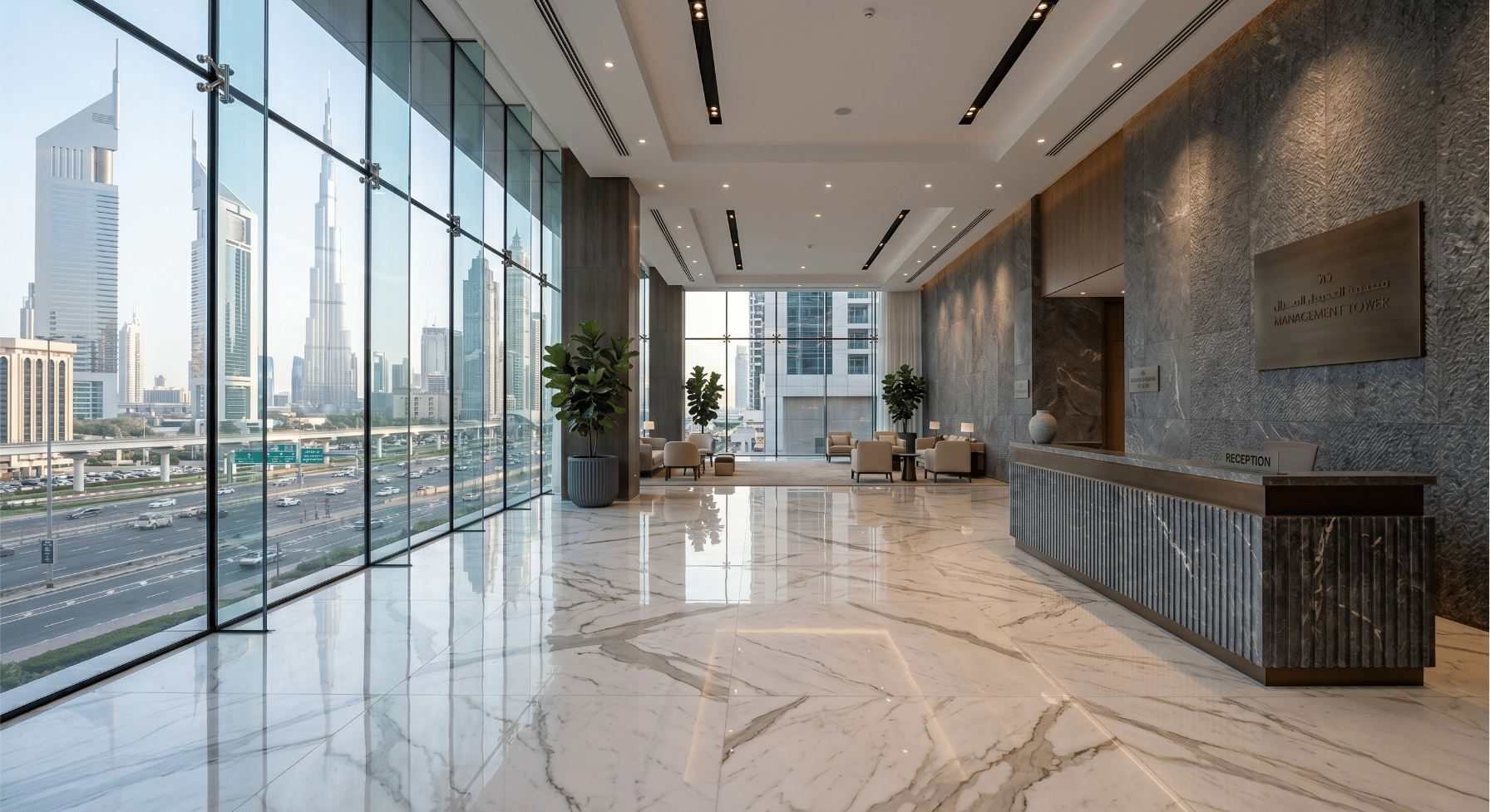
For retail showrooms, hotel lobbies, and corporate reception areas in Dubai, large-format polished or satin porcelain in marble-look or concrete-look designs has become the defining commercial floor aesthetic of the current decade. It delivers the luxury visual of marble or stone at lower cost, with full commercial durability and no sealing requirements.
Commercial Porcelain for Specific Environments
• Retail — Large format, polished or satin finish, marble or concrete visual. Prioritise a slip-resistant specification in areas near building entrances where wet footwear from outside is tracked in.
• Office — Mid-format matte or satin finish, neutral grey or warm stone tones. Large format in reception and breakout areas, standard format in open-plan office floors.
• Restaurant — Matte anti-slip finish, R11 rated, in the dining area. R12 commercial kitchen tile in the kitchen and preparation areas. Consider warm, textured formats that create an inviting atmosphere without sacrificing practicality.
• Hotel lobby — Large format polished or book-matched slabs for maximum visual impact. Heated in some premium installations to eliminate the cool feeling of stone in an air-conditioned lobby.
• Clinic and healthcare — Seamless or minimal-joint tile in light colours, anti-bacterial grout, easy to clean to clinical standards. Slip resistance R10 minimum in patient areas.
Cost in Dubai (2025 Estimate)
• Commercial grade porcelain, mid-format, Class 33: AED 85 to 160 per sqm supply and install.
• Large-format commercial porcelain, 120 by 120 cm: AED 160 to 300 per sqm.
• Premium Italian commercial porcelain: AED 250 to 500 per sqm.
Find and compare commercial tile flooring professionals in Dubai on Taamir →
4. Marble and Natural Stone — Prestige in High-End Commercial
In Dubai's competitive luxury commercial market — five-star hotels, premium retail, high-end restaurant groups, private banking lobbies, and luxury residential sales offices — marble and natural stone are not merely a design choice. They are a statement of positioning. The investment in real marble tells visitors immediately that this is a business that does not compromise on quality, and in a market as design-literate and status-conscious as Dubai, that message is understood and valued.
The commercial application of marble in Dubai follows different rules from residential use. In a hotel lobby or a luxury retail flagship that is cleaned professionally every night by a trained facilities team, the maintenance requirements of marble are entirely manageable. The sealing regime, the pH-neutral cleaning protocols, the immediate treatment of spills — all of this is part of a facilities management contract that the business operates as standard. The maintenance burden that makes marble impractical for a busy residential family bathroom is not a problem in a professionally managed commercial environment.
Marble Grades for Commercial Use
Commercial marble installations in Dubai use either premium-grade slabs — hand-selected for consistency of tone and veining, cut in large formats and often book-matched — or a more economical commercial tile grade where some variation is accepted for a significant cost saving. The slab approach is used in luxury hotel lobbies, flagship retail, and branded commercial spaces where visual perfection is non-negotiable. The tile grade approach is used in professional offices, medical suites, and commercial spaces where the prestige of real marble is desired but the budget does not extend to the full luxury specification.
Granite in Commercial Environments
Granite is the most durable natural stone available and the preferred choice for high-traffic commercial entry areas, shopping mall concourses, and any commercial floor that must resist both heavy foot traffic and the aggressive cleaning regimes of commercial facilities management. Its hardness means it resists scratching from grit tracked in on footwear — a significant practical advantage in Dubai where fine sand is carried on shoes year-round. Polished granite in commercial lobbies has a formality and authority that marble and porcelain approach but do not fully replicate.
Cost in Dubai (2025 Estimate)
• Commercial marble tile grade, standard format: AED 200 to 380 per sqm.
• Premium marble slabs, book-matched lobby installation: AED 400 to 800 per sqm.
• Polished granite, commercial entry areas: AED 200 to 400 per sqm.
Find and compare marble and stone flooring professionals in Dubai on Taamir →
5. Epoxy Flooring — Industrial Strength, Design Potential
Epoxy flooring is the dominant choice for commercial environments where hygiene, chemical resistance, and seamless cleanability are the primary requirements — commercial kitchens, food processing areas, laboratories, car showrooms, warehouses, and any industrial or semi-industrial commercial space in Dubai. It is also increasingly specified in design-conscious commercial interiors — showrooms, creative agency offices, fitness studios, and automotive retail — where the seamless, industrial aesthetic of a well-executed epoxy floor communicates a brand identity that tile or stone cannot.
In commercial applications, epoxy is most commonly applied as a self-levelling system on a prepared concrete substrate, producing a perfectly flat, seamless surface with no grout lines, no joints, and no voids where bacteria or food debris can accumulate. The surface hardness of a commercial epoxy floor exceeds that of most natural stones, and its chemical resistance — to oils, acids, alkalis, cleaning agents, and most commercial solvents — makes it appropriate for environments where other flooring materials would degrade rapidly.
Commercial Epoxy System Types
• Self-levelling epoxy — Poured and screeded to a flat finish. The standard for commercial kitchens, food production, and clean rooms. Available in standard commercial grey, a range of solid colours, and metallic finishes for design-led spaces.
• Quartz broadcast epoxy — Coloured quartz aggregates broadcast into the wet epoxy surface to produce a textured, anti-slip finish. The standard for commercial spaces where both hygiene and slip resistance are critical — commercial kitchens, car wash facilities, food and beverage back-of-house.
• Metallic epoxy — Pearlescent metallic pigments in a clear epoxy system producing fluid, cloud-like patterns. Used in commercial showrooms, reception areas, and design-led retail where visual impact is a priority.
• Anti-static epoxy — Formulated to dissipate static electricity. Used in server rooms, electronics manufacturing, and any commercial environment where static charge is a risk to equipment or personnel.
• Polyurethane epoxy systems — A hybrid system with greater flexibility and UV stability than standard epoxy. Appropriate for food and beverage environments where thermal shock from steam cleaning is a factor.
Key Considerations for Commercial Epoxy in Dubai
Substrate preparation is even more critical in commercial epoxy than residential applications. A commercial floor that is closed for re-epoxying because of delamination failure is a business disruption as well as a remediation cost. The substrate must be shot-blasted or diamond-ground to create an adequate surface profile, tested for moisture content, and primed correctly before any epoxy is applied. Shortcuts in substrate preparation are the most common cause of commercial epoxy failure in Dubai.
The other critical consideration is thermal shock resistance. Commercial kitchens that are steam-cleaned daily subject the floor surface to rapid temperature changes that standard epoxy systems cannot withstand over time. In commercial kitchen specifications, polyurethane epoxy or polyurethane screed systems — which have greater flexibility and thermal shock resistance — are the appropriate specification rather than standard epoxy.
Cost in Dubai (2025 Estimate)
• Self-levelling solid colour epoxy, commercial grade: AED 100 to 180 per sqm.
• Quartz broadcast anti-slip epoxy system: AED 150 to 250 per sqm.
• Metallic epoxy, design commercial spaces: AED 200 to 400 per sqm.
• Polyurethane screed for commercial kitchens: AED 250 to 450 per sqm.
Find and compare commercial epoxy flooring specialists in Dubai on Taamir →
6. Micro Cement — The Boutique Commercial Finish
Micro cement has moved firmly into the commercial design vocabulary in Dubai over the past four years. It is now a standard specification for boutique retail, premium fitness studios, concept restaurants, beauty and wellness spaces, and any commercial interior where the owner or designer wants a finish that feels considered, artisanal, and distinctly different from the large-format porcelain that dominates most Dubai commercial spaces.
The commercial appeal of micro cement is its seamlessness and its neutrality. Applied over existing floors and walls in thin coats, it creates a continuous surface with no grout lines and no pattern interruptions — a quality that allows the merchandise, the furniture, or the brand experience to take the foreground rather than competing with a complex floor design. In a Dubai concept store or wellness studio, a floor and wall in the same micro cement tone creates a cohesive spatial quality that is immediately recognisable as premium.
Commercial Micro Cement Performance Requirements
Micro cement in commercial use must be specified to a higher sealing standard than residential applications. A boutique retail space with significant daily foot traffic requires a minimum of six to eight coats of polyurethane topcoat — rather than the four to six coats appropriate for a residential bathroom — to achieve the wear resistance needed for commercial use. The topcoat specification must include UV stability if the space has significant natural light exposure, anti-slip properties appropriate to the commercial environment, and chemical resistance suitable for the cleaning regime the facilities team will apply.
It is also worth being clear about the maintenance commitment. Micro cement floors in busy commercial environments will show wear at high-traffic nodes — in front of service counters, at entrance thresholds, along primary circulation routes — within two to four years depending on foot traffic intensity. Re-sealing or a full topcoat renewal at these points is a planned maintenance activity that should be budgeted for from the outset rather than treated as a failure.
Best Commercial Applications for Micro Cement in Dubai
• Boutique retail — Seamless floors and walls in a warm neutral tone create a backdrop that lets the product speak.
• Wellness and beauty studios — The spa-like quality of micro cement suits yoga studios, pilates spaces, beauty salons, and massage clinics.
• Concept restaurants and cafes — Applied to floors, walls, and counters, micro cement creates an interior of great textural consistency.
• Private members' clubs and premium co-working spaces — The material communicates restraint and quality simultaneously.
• Hotel suites and serviced apartment lobbies — For operators who want to differentiate from the standard large-format porcelain aesthetic.
Cost in Dubai (2025 Estimate)
• Commercial micro cement floor, standard specification: AED 220 to 380 per sqm.
• Commercial micro cement floor with premium sealing and UV-stable topcoat: AED 350 to 550 per sqm.
• Full commercial space — floor and walls combined: AED 280 to 500 per sqm of floor area.
Find and compare micro cement flooring specialists in Dubai on Taamir →
7. SPC Vinyl — Practical, Fast, and Design-Flexible
Stone Polymer Composite vinyl is the most practical commercial flooring choice for Dubai businesses that need a quality result, a fast installation, and a floor that handles heavy daily use without specialist maintenance. Its combination of full waterproofing, commercial-grade wear layers, broad design range, and click-lock installation that requires no adhesive and no curing time makes it the dominant choice for Dubai retail fit-outs, office refurbishments, and commercial renovation projects where operational downtime is a primary concern.
The commercial specification of SPC vinyl differs from the residential version in the wear layer thickness — the most important performance variable in SPC. Residential SPC typically uses a 0.3 to 0.5mm wear layer, which is adequate for home use but will wear through within one to two years under commercial foot traffic. Commercial SPC flooring uses a wear layer of 0.55mm to 0.8mm, with heavy commercial grades at 0.7mm and above. Always verify wear layer thickness and usage class rating when specifying SPC for a commercial project in Dubai.
Where SPC Performs Best in Commercial Settings
• Retail fit-outs — Fast installation with no adhesive and minimal floor preparation means a retail unit can be floored and ready to trade within one to two days. Damaged planks can be replaced individually without closing the store.
• Office refurbishments — SPC can be laid over existing tiles or concrete with minimal preparation, avoiding the disruption and cost of full demolition. The click-lock system allows installation in phases around active workstations.
• Clinic and medical spaces — Fully waterproof, easy to clean, available in light neutral tones appropriate for healthcare environments, and low-maintenance for facilities teams.
• Serviced apartments and short-term rental properties — Combines the wood or stone aesthetic demanded by premium rental guests with the durability and waterproofing required for high-turnover occupancy.
• Education facilities — Comfortable and quiet underfoot, easy to clean, durable under the constant movement of a school or training facility environment.
Commercial SPC Limitations
Commercial SPC is not appropriate for commercial kitchens, food production areas, or any commercial environment where the floor will be cleaned with steam equipment or very hot water — the polymer core softens under sustained high temperatures. For these environments, epoxy or porcelain tile are the correct specifications. SPC is also not appropriate for outdoor commercial areas or any space with direct sun exposure, where UV degradation will occur rapidly.
Cost in Dubai (2025 Estimate)
• Commercial SPC, 0.55mm wear layer, Class 33: AED 90 to 160 per sqm.
• Heavy commercial SPC, 0.7mm wear layer, Class 34: AED 150 to 250 per sqm.
Find and compare SPC vinyl flooring professionals in Dubai on Taamir →
8. Carpet — Offices, Hotels, and Acoustic Spaces
Carpet in commercial environments in Dubai serves a specific and valuable function that hard flooring cannot replicate — acoustic management, thermal comfort, and the reduction of fatigue in environments where people stand or walk for extended periods. In Dubai's corporate office market, carpet tile systems — modular carpet squares that can be replaced individually rather than requiring full-floor replacement — are the dominant flooring specification for open-plan office floors, meeting rooms, and hotel guest room corridors.
The commercial carpet market in Dubai is distinct from residential. Commercial carpet products are specified by their Wilton or tufted construction, their pile weight per square metre, their backing system, and their Class rating under EN 1307. The same durability logic applies as with all commercial flooring — a product specified below its appropriate usage class will show wear patterns within months in a busy Dubai office or hotel corridor.
Carpet Tile vs. Broadloom in Commercial Settings
Carpet tile — modular 50 by 50 cm or 100 by 25 cm squares — is the professional standard for commercial offices and hotel back-of-house in Dubai. When a section of carpet tile is damaged or heavily stained, individual tiles are replaced without disrupting the rest of the floor. This modular replaceability is a significant maintenance and lifecycle cost advantage over broadloom in high-traffic commercial environments where isolated heavy wear is inevitable. Broadloom carpet remains the preferred choice for hotel guest rooms, boardrooms, and executive offices where the seamless, uninterrupted quality of a single continuous carpet creates a more refined finish.
Acoustic Performance in Dubai Commercial Spaces
Open-plan office design has become the standard in Dubai's corporate market — DIFC, Business Bay, Downtown, JLT, and the free zones are full of open-plan layouts with hard ceilings, glass partitions, and large volumes that create significant acoustic challenges. Carpet is the most effective single material intervention for acoustic management in these spaces, absorbing airborne sound and reducing the impact noise from footfall that hard floors transmit directly to occupants below. In open-plan Dubai offices where acoustic comfort is a productivity issue, carpet on the floor combined with acoustic ceiling tiles delivers dramatic results.
Cost in Dubai (2025 Estimate)
• Commercial carpet tile, Class 33, standard loop pile: AED 70 to 140 per sqm.
• Premium commercial carpet tile, Class 34, cut and loop: AED 140 to 240 per sqm.
• Hotel broadloom, guest rooms and corridors: AED 120 to 280 per sqm.
Find and compare commercial carpet flooring professionals in Dubai on Taamir →
9. Parquet and Wood — Warmth in Commercial Interiors
Wood flooring in commercial settings communicates warmth, craftsmanship, and a human quality that no other flooring material fully replicates. In Dubai's commercial market, engineered wood and parquet appear most frequently in premium restaurants, boutique hotels, high-end retail, private members' clubs, and corporate boardrooms and executive offices where the character of the space is as important as its functionality.
The commercial specification of wood flooring follows the same principles as residential but with higher performance requirements. The wear layer of engineered commercial wood must be at least 4mm to allow the number of sanding and refinishing cycles that commercial use may require over the floor's lifetime. The surface finish must be either a heavy-duty commercial lacquer — applied in more coats than a residential lacquer to build a harder, thicker protective film — or a hardwax oil with a protective maintenance programme that the facilities team commits to. The species must be hard enough for commercial foot traffic — European oak, ash, and bamboo are appropriate; softer species like pine and cedar are not.
Herringbone Parquet in Dubai Commercial
Herringbone parquet has become one of the signature floor designs of Dubai's premium commercial market over the past three years. In a restaurant, a boutique hotel lobby, a private members' club bar, or a luxury fashion retail environment, wide-plank herringbone in smoked or natural oak creates an interior of immediate quality that communicates to customers exactly where they are in the market. It is a floor that is associated with the best addresses in London, Paris, and New York, and its appearance in Dubai commercial spaces signals an understanding of global design standards.
Commercial Wood Flooring Maintenance
The maintenance commitment for commercial wood flooring must be built into the facilities management plan from the start. Daily cleaning should use only pH-neutral, wood-safe cleaners — the standard commercial cleaning agents used elsewhere in a building will damage a wood floor rapidly. Periodic re-oiling or re-coating must be scheduled and budgeted. High-traffic areas — in front of a restaurant host station, at a bar rail, along a retail aisle — will require spot-sanding and re-finishing within three to five years even with excellent routine maintenance. These are known, plannable costs, not surprises.
Cost in Dubai (2025 Estimate)
• Commercial engineered oak, straight plank: AED 220 to 380 per sqm.
• Commercial herringbone parquet, engineered oak: AED 320 to 550 per sqm.
• Wide-plank smoked oak, premium commercial: AED 400 to 700 per sqm.
Find and compare parquet and wood flooring professionals in Dubai on Taamir →
10. Space-by-Space Recommendations
Corporate Office — Open Plan
Commercial carpet tile is the dominant choice for open-plan Dubai offices and remains the most appropriate for acoustic management, comfort underfoot, and modular replacement when sections wear or are damaged. SPC vinyl in a wood or stone design is the alternative for offices that prefer the visual of a hard floor with commercial durability and easy maintenance. Large-format matte porcelain tile is used in offices where a hard, minimal aesthetic is the design intent.
Corporate Office — Reception and Lobby
The reception area is the most visible commercial floor in an office building and justifies a premium specification. Large-format polished porcelain in a marble visual, real marble tile, or polished granite creates the authoritative entrance that corporate positioning demands in Dubai. Micro cement in a sophisticated neutral tone is a design-forward alternative for businesses that want to differentiate from the standard marble lobby aesthetic.
Restaurant — Dining Area
Restaurant dining floors in Dubai must handle food and drink spills, chair movement across the surface thousands of times per service, and daily cleaning with commercial degreasing agents. Anti-slip matte or satin porcelain tile is the most reliable choice. Engineered wood or parquet in a restaurant dining room creates warmth and character that tile cannot match — but requires a rigorous maintenance plan and a floor manager who understands wood care. SPC vinyl in a wood design is the practical alternative that delivers a similar aesthetic with fewer maintenance demands.
Restaurant — Commercial Kitchen
Commercial kitchens in Dubai require a floor that meets the Dubai Municipality food safety regulations — seamless or near-seamless, slip resistant at R12 minimum, chemically resistant, and capable of surviving daily high-pressure or steam cleaning. Polyurethane screed or quartz-broadcast epoxy are the professional specifications. Standard ceramic tile with cement grout is found in many existing Dubai commercial kitchens but is not the recommended specification for new installations — the grout lines harbour bacteria and the cement grout degrades rapidly under commercial kitchen cleaning regimes.
Retail — Luxury and Fashion
Luxury retail flooring in Dubai communicates brand positioning before the customer reads a single piece of signage. Premium brands in Dubai Mall, City Walk, and the high-end retail corridors of Jumeirah and DIFC use marble, large-format polished porcelain in marble visuals, or herringbone parquet as their primary floor specification. The floor in a luxury retail space must be maintained to a very high standard — any visible wear, grout discolouration, or surface dullness devalues the brand environment immediately.
Retail — Mass Market and F&B
For mass-market retail, food and beverage chains, and high-footfall quick-service environments in Dubai, the priority shifts entirely to durability, slip resistance, and cleaning speed. Commercial-grade porcelain at Class 34 in an anti-slip matte finish is the standard. Epoxy is appropriate in food service areas where hygienic seamlessness is a regulatory requirement. SPC vinyl is used by many F&B chains for its combination of commercial durability and fast installation that minimises fit-out time.
Medical and Healthcare
Clinic, hospital, and healthcare flooring in Dubai is subject to Dubai Health Authority guidelines and Dubai Civil Defence fire classifications. The floor must be seamless or near-seamless for hygienic cleanability, anti-slip to protect patients with limited mobility, anti-fatigue for clinical staff who stand for extended periods, and available in light colours that allow easy visual inspection of floor cleanliness. Homogeneous vinyl sheet flooring — a single-layer, full-thickness vinyl without a print layer — is the international clinical standard and is widely available in Dubai. Porcelain tile with epoxy grout and R10 anti-slip finish is the appropriate tile alternative. Carpet is not appropriate in clinical areas.
Hotel — Public Areas and Lobby
Hotel lobby flooring in Dubai is among the most demanding commercial application of any flooring material. It must handle thousands of guest movements per day, be maintained to an immaculate standard around the clock, communicate the hotel's brand and positioning to every arriving guest, and last for the full life of the hotel's interior — typically ten to fifteen years between major refurbishments. Large-format marble, book-matched stone slabs, and premium polished porcelain are the standard specifications for Dubai hotel lobbies. The investment is substantial, but the floor of a hotel lobby in Dubai is seen by more people per day than almost any other surface in the building.
Hotel — Guest Rooms and Corridors
Hotel guest rooms in Dubai use a combination of hard flooring at the entrance and in the bathroom — typically porcelain tile or SPC vinyl — and carpet in the sleeping area, where the acoustic and thermal comfort of soft flooring is a meaningful contributor to the guest experience. Hotel corridors use broadloom carpet or carpet tile in the majority of Dubai properties, for acoustic management and the warmth that high volumes of marble and tile in public areas would otherwise make oppressive.
Fitness and Wellness
Commercial gyms, yoga studios, and wellness spaces in Dubai require flooring that absorbs impact, resists moisture from sweat and cleaning, provides appropriate grip for barefoot and sports-shod use, and is easy to sanitise. Rubber flooring is the standard for gym floor areas — it absorbs the impact of dropped weights and provides the resilience that exercise demands. Micro cement and polished porcelain are used in reception, changing room, and studio areas where design is a priority alongside performance.
Find and compare commercial flooring professionals for every space type on Taamir →
11. Wear Ratings and Commercial Grade Explained
The EN 685 usage class system is the most important technical specification to understand when purchasing commercial flooring in Dubai. It classifies flooring products by the intensity of use they are designed to withstand, from light residential to heavy industrial.
EN 685 Usage Classes
• Class 21 — Light residential. Single-person low-traffic rooms. Not appropriate for any commercial use.
• Class 22 — Moderate residential. Standard residential rooms. Not appropriate for commercial use.
• Class 23 — Heavy residential. High-traffic residential areas, staircases. Not appropriate for commercial use.
• Class 31 — Light commercial. Very low-traffic commercial areas — small private offices with minimal visitor traffic.
• Class 32 — Moderate commercial. Standard offices, small retail, meeting rooms with regular but not heavy traffic.
• Class 33 — Heavy commercial. Large offices, retail stores, restaurants, hotel rooms. The minimum for most Dubai commercial applications.
• Class 34 — Very heavy commercial. Shopping malls, airports, hotel lobbies, public concourses with very high footfall.
• Class 41 and above — Light to heavy industrial. Warehouses, logistics facilities, industrial production areas.
A product installed below its appropriate usage class will show accelerated wear — typically within six to eighteen months in a busy Dubai commercial environment. Always ask for the EN 685 usage class certificate for any commercial flooring product before purchase, and match the class to the realistic daily foot traffic of the specific space.
Find and compare commercial flooring professionals who specify correctly on Taamir →
12. Frequently Asked Questions
What is the most durable flooring for a commercial space in Dubai?
For commercial environments with very high foot traffic — hotel lobbies, shopping mall concourses, restaurant dining areas — large-format porcelain tile at Class 34 with epoxy grout is the most durable widely available specification. For industrial and semi-industrial commercial environments — commercial kitchens, warehouses, car showrooms — polyurethane screed or quartz broadcast epoxy delivers greater chemical resistance and seamless cleanability.
What flooring is best for a Dubai office?
Commercial carpet tile is the dominant choice for open-plan Dubai offices — it manages acoustics, is comfortable underfoot, and allows individual tile replacement rather than full-floor renewal when sections wear. For reception and lobby areas, large-format polished porcelain or marble creates the authoritative first impression that corporate positioning in Dubai demands. SPC vinyl is the practical alternative for office spaces undergoing rapid fit-out where installation speed is a priority.
What do I need for a commercial kitchen floor in Dubai?
Dubai Municipality food safety regulations require commercial kitchen floors to be smooth, non-porous, slip resistant, and cleanable to a hygienic standard. Polyurethane screed is the professional recommendation — it is seamless, thermally resistant to steam cleaning, chemically resistant to commercial kitchen cleaning agents, and can be specified with anti-slip aggregate at R12. Quartz broadcast epoxy is a good alternative. Standard ceramic tile with cement grout does not meet the spirit of Dubai food safety standards and is not recommended for new commercial kitchen installations.
How much does commercial flooring cost in Dubai?
Commercial flooring in Dubai ranges from AED 70 per sqm for standard commercial carpet tile to AED 800 per sqm and above for premium book-matched marble in a hotel lobby. The most widely used mid-range commercial specifications — commercial porcelain tile, commercial SPC vinyl, and commercial carpet tile — typically fall between AED 90 and 180 per sqm supply and install for spaces of 200 sqm and above.
Can I install new commercial flooring over existing tiles in Dubai?
In many cases, yes. SPC vinyl can be installed over existing sound tiles with minimal preparation, avoiding demolition and the associated disruption and cost. Micro cement can also be applied over existing tiles. Epoxy and new porcelain tile typically require the existing floor to be removed or abraded to achieve the required bond. A professional assessment of the existing floor condition — levelness, bond integrity, moisture content — should always precede a decision to overlay rather than demolish.
How do I minimise business disruption during a commercial flooring installation?
Phased installation — working on one section of the space at a time while the rest remains operational — is the most common approach. SPC vinyl with a click-lock system is the easiest material to install in phases with minimal equipment and curing time. Epoxy and large-format porcelain require closed sections for twenty-four to seventy-two hours during installation and curing. Work-outside-of-hours installation — evenings and weekends — is common for retail and food and beverage fit-outs in Dubai where daytime trading cannot be interrupted.
Does Taamir work with commercial clients in Dubai?
Yes. On Taamir you can find and compare flooring professionals in Dubai who have experience in commercial projects — offices, retail, restaurants, hotels, clinics, and more. Browse their profiles, see their previous commercial projects, and compare their experience before making a decision.
Find and compare commercial flooring professionals in Dubai on Taamir →
Find the Right Professional for Your Commercial Floor in Dubai
On Taamir you can find and compare flooring professionals in Dubai who specialise in commercial projects across every space type covered in this guide. Browse their profiles, see their previous projects, and find the right professional for your business.